
Return Stacking with Fast and Slow Diversification: A Framework for Market Volatility
Overview
Diversification is crucial for managing portfolio risk, yet not all diversification strategies respond simultaneously during equity drawdowns. By understanding the roles of immediate responders (e.g., volatility strategies), delayed responders (e.g., managed futures), and diversifiers (strategies offering differentiated returns in flat markets), and employing return stacking, financial advisors can potentially build more resilient portfolios without sacrificing core stock and bond exposures.
Key Topics
Portfolio Construction, Return Stacking, Portable Alpha, Diversification
Introduction
Diversification has long been described as the only free lunch in investing—a phrase famously attributed to Nobel laureate Harry Markowitz. For financial advisors aiming to protect client portfolios during turbulent markets, incorporating alternative strategies into diversification efforts is increasingly essential. However, not all diversification strategies respond at the same pace during equity market drawdowns. By understanding the different roles played by “immediate responders,” “delayed responders,” and “diversifiers,” and by applying innovative techniques such as return stacking, advisors can help clients navigate volatility without reducing core stock and bond allocations.
The Varying Response of Diversification Strategies
Diversification is a cornerstone of sound portfolio construction, but not all diversification is created equal—especially during periods of market stress. Traditional diversification through equities and fixed income offers some protection, but this benefit often diminishes during significant market downturns when asset correlations rise.
To build portfolios that are more robust in these environments, many advisors now turn to liquid alternative strategies. These can be grouped into three broad categories, each serving a distinct function:
Immediate Responders: These strategies, such as long volatility and certain option-based approaches, are designed to react quickly at the onset of market stress. They tend to benefit from spikes in volatility and sudden equity market declines. As a result, they can provide meaningful risk mitigation during the initial phases of a drawdown.
Figure 1: Performance During the First 10% of Equity Drawdowns
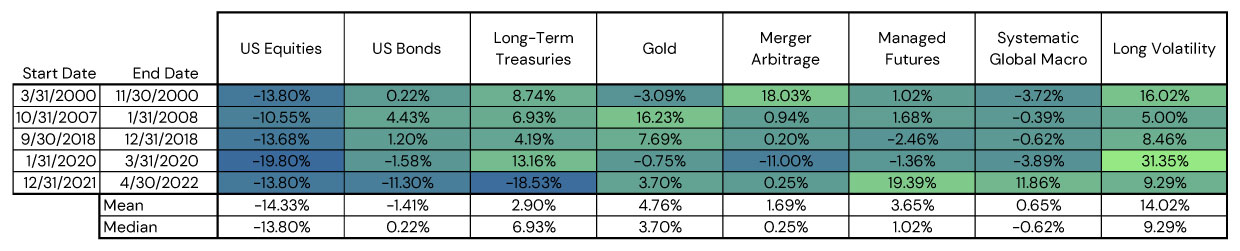
Source: Bloomberg, PivotalPath, Solactive, and EurekaHedge. Calculations by Newfound Research. US Equities is the MSCI USA (USD) Total Return Index. US Bonds is the Bloomberg US Agg Total Return Value Unhedged Index USD. Long-Term Treasuries is the Bloomberg US Long Treasury Total Return TR Index Value Unhedged USD Index. Merger Arbitrage is the PivotalPath Event Driven: Merger Arbitrage Index. Managed Futures is the PivotalPath Managed Futures Index. Systematic Global Macro is the PivotalPath Global Macro: Quantitative Index. Global Stock/Bond Momentum is the Newfound/ReSolve Robust Equity Momentum TR Index. Long Volatility is the PivotalPath Volatility Trading Index from December 1999 to December 2004 and the EurekaHedge Long Volatility Hedge Fund Index from January 2004 to December 2024. Past performance is not indicative of future results. Performance is gross of all fees, taxes, and transaction costs. Performance assumes the reinvestment of all distributions. Performance of the PivotalPath Managed Futures Index, Global Macro: Quantitative Index, Event Driven: Merger Arbitrage Index, and EurekaHedge Long Volatility Hedge Fund Index are net of underlying management and performance fees. Investors cannot invest directly in an index. Performance data is for illustrative purposes only and does not represent actual returns of a specific fund or investment product.
Delayed Responders: Strategies like managed futures and trend-following often require more persistent market trends to be effective. While they may lag during early selloffs, they have historically added value in extended downturns or prolonged bear markets. Their role is to respond dynamically to evolving market conditions rather than sudden dislocations.
Figure 2: Performance During the Second 10% Drawdown in Equities (10-20%)
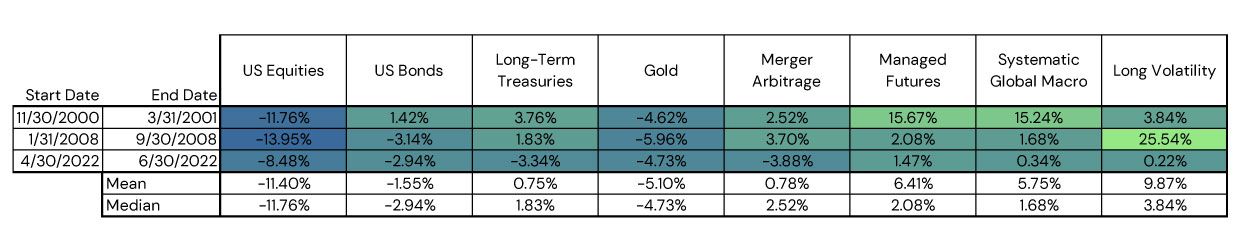
Source: Bloomberg, PivotalPath, Solactive, and EurekaHedge. Calculations by Newfound Research. US Equities is the MSCI USA (USD) Total Return Index. US Bonds is the Bloomberg US Agg Total Return Value Unhedged Index USD. Long-Term Treasuries is the Bloomberg US Long Treasury Total Return TR Index Value Unhedged USD Index. Merger Arbitrage is the PivotalPath Event Driven: Merger Arbitrage Index. Managed Futures is the PivotalPath Managed Futures Index. Systematic Global Macro is the PivotalPath Global Macro: Quantitative Index. Global Stock/Bond Momentum is the Newfound/ReSolve Robust Equity Momentum TR Index. Long Volatility is the PivotalPath Volatility Trading Index from December 1999 to December 2004 and the EurekaHedge Long Volatility Hedge Fund Index from January 2004 to December 2024. Past performance is not indicative of future results. Performance is gross of all fees, taxes, and transaction costs. Performance assumes the reinvestment of all distributions. Performance of the PivotalPath Managed Futures Index, Global Macro: Quantitative Index, Event Driven: Merger Arbitrage Index, and EurekaHedge Long Volatility Hedge Fund Index are net of underlying management and performance fees. Investors cannot invest directly in an index. Performance data is for illustrative purposes only and does not represent actual returns of a specific fund or investment product.
Figure 3: Performance During the Remaining Equity Drawdown (20%+)

Source: Bloomberg, PivotalPath, Solactive, and EurekaHedge. Calculations by Newfound Research. US Equities is the MSCI USA (USD) Total Return Index. US Bonds is the Bloomberg US Agg Total Return Value Unhedged Index USD. Long-Term Treasuries is the Bloomberg US Long Treasury Total Return TR Index Value Unhedged USD Index. Merger Arbitrage is the PivotalPath Event Driven: Merger Arbitrage Index. Managed Futures is the PivotalPath Managed Futures Index. Systematic Global Macro is the PivotalPath Global Macro: Quantitative Index. Long Volatility is the PivotalPath Volatility Trading Index from December 1999 to December 2004 and the EurekaHedge Long Volatility Hedge Fund Index from January 2004 to December 2024. Past performance is not indicative of future results. Performance is gross of all fees, taxes, and transaction costs. Performance assumes the reinvestment of all distributions. Performance of the PivotalPath Managed Futures Index, Global Macro: Quantitative Index, Event Driven: Merger Arbitrage Index, and EurekaHedge Long Volatility Hedge Fund Index are net of underlying management and performance fees. Investors cannot invest directly in an index. Performance data is for illustrative purposes only and does not represent actual returns of a specific fund or investment product.
Diversifiers: These strategies are typically uncorrelated to equity market direction and are not necessarily intended to hedge equity risk. Instead, they seek differentiated sources of return, particularly in sideways or range-bound markets. Systematic Global Macro, Merger Arbitrage, Managed Futures Carry (Yield), and other alternative strategies fall into this category. Their primary value lies in their ability to contribute stable returns across varying market conditions.
Figure 4: Excess Returns During the 2008 Crisis
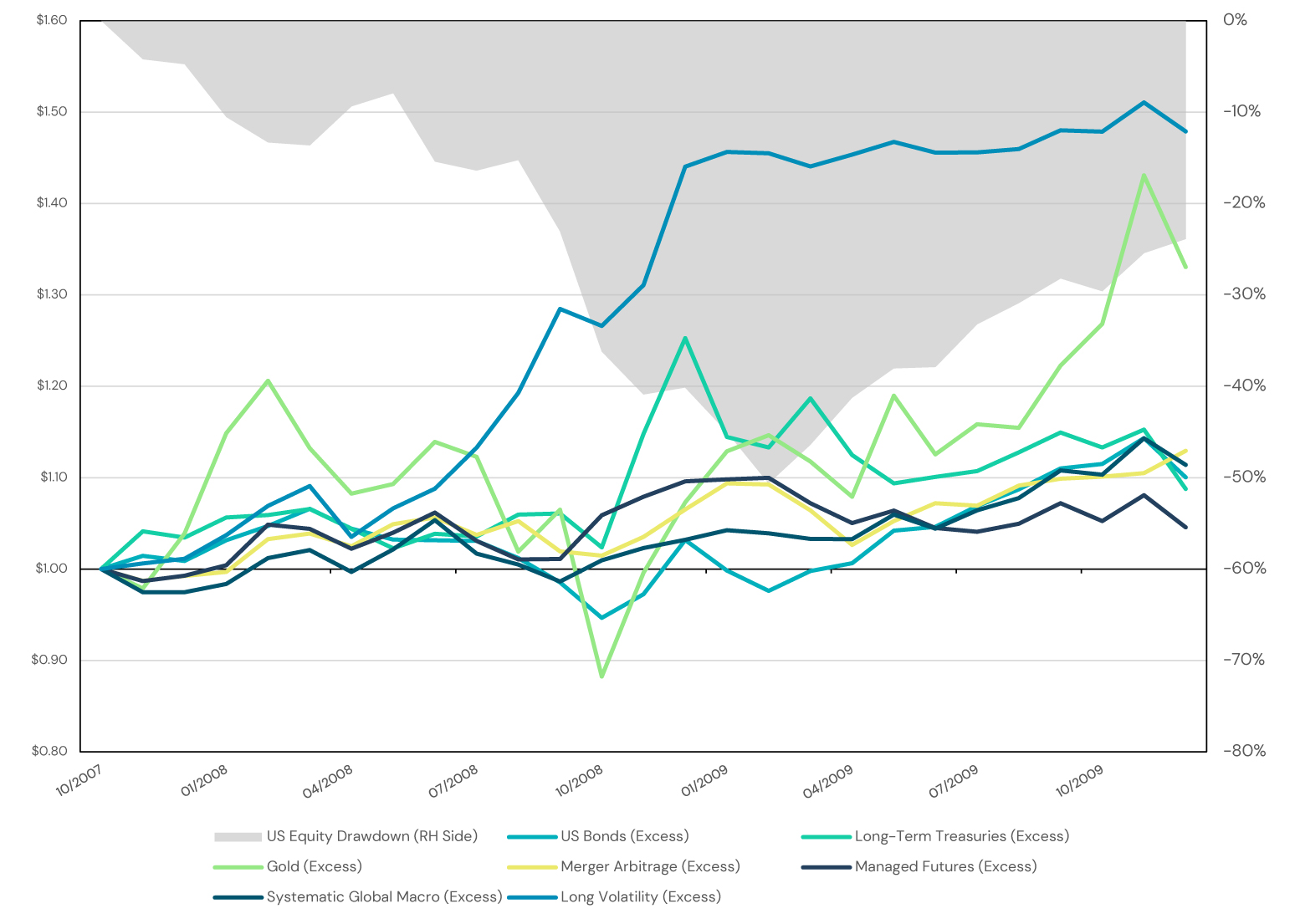
Source: Bloomberg, PivotalPath, Solactive, and EurekaHedge. Calculations by Newfound Research. Excess returns are in excess of the Bloomberg Short Treasury Total Return Index Value Unhedged USD (“LD12TRUU”). US Equities is the MSCI USA (USD) Total Return Index. US Bonds is the Bloomberg US Agg Total Return Value Unhedged Index USD. Long-Term Treasuries is the Bloomberg US Long Treasury Total Return TR Index Value Unhedged USD Index. Merger Arbitrage is the PivotalPath Event Driven: Merger Arbitrage Index. Managed Futures is the PivotalPath Managed Futures Index. Systematic Global Macro is the PivotalPath Global Macro: Quantitative Index. Long Volatility is the PivotalPath Volatility Trading Index from December 1999 to December 2004 and the EurekaHedge Long Volatility Hedge Fund Index from January 2004 to December 2024. Past performance is not indicative of future results. Performance is gross of all fees, taxes, and transaction costs. Performance assumes the reinvestment of all distributions. Performance of the PivotalPath Managed Futures Index, Global Macro: Quantitative Index, Event Driven: Merger Arbitrage Index, and EurekaHedge Long Volatility Hedge Fund Index are net of underlying management and performance fees. Investors cannot invest directly in an index. Performance data is for illustrative purposes only and does not represent actual returns of a specific fund or investment product.
Diversifiers: These strategies are typically uncorrelated to equity market direction and are not necessarily intended to hedge equity risk. Instead, they seek differentiated sources of return, particularly in sideways or range-bound markets. Systematic Global Macro, Merger Arbitrage, Managed Futures Carry (Yield), and other alternative strategies fall into this category. Their primary value lies in their ability to contribute stable returns across varying market conditions.
Register for our Advisor Center
Tools Center:
Easily backtest & explore different return stacking concepts
Model Portfolios:
Return stacked allocations, commentary and guidance designed
for a range of client risk profiles and goals
Future Thinking:
Receive up-to-date insights into the world of return stacking theory and practice

Implementing a Layered Approach Through Return Stacking
Understanding the timing and function of these strategies is critical. Advisors should communicate clearly with clients that not all strategies are intended to respond simultaneously—or even at all—to every form of equity market stress. Managing these expectations can strengthen advisor-client relationships, especially during periods of uncertainty.
A practical challenge lies in how to incorporate these approaches without reducing the portfolio’s exposure to traditional assets that are essential for long-term growth and income. Return stacking offers a potential solution. By layering complementary strategies on top of core allocations, advisors can create diversified exposures without displacing foundational stock and bond investments.
For example, advisors might stack volatility overlays, trend-following sleeves, or other diversifying strategies within the same portfolio. This approach allows each strategy to contribute during different phases of market stress—immediate responders during sharp drawdowns, delayed responders during prolonged declines, and diversifiers in low-volatility environments.
Conclusion
Return stacking provides an opportunity to enhance diversification without compromising long-term return potential. By structuring portfolios in this way, advisors can avoid the traditional trade-offs between core exposure and alternative strategies. Instead, they can offer clients a more dynamic form of diversification that adapts to a range of market conditions.
Figure 5: Hedging Effectiveness by Market Scenario
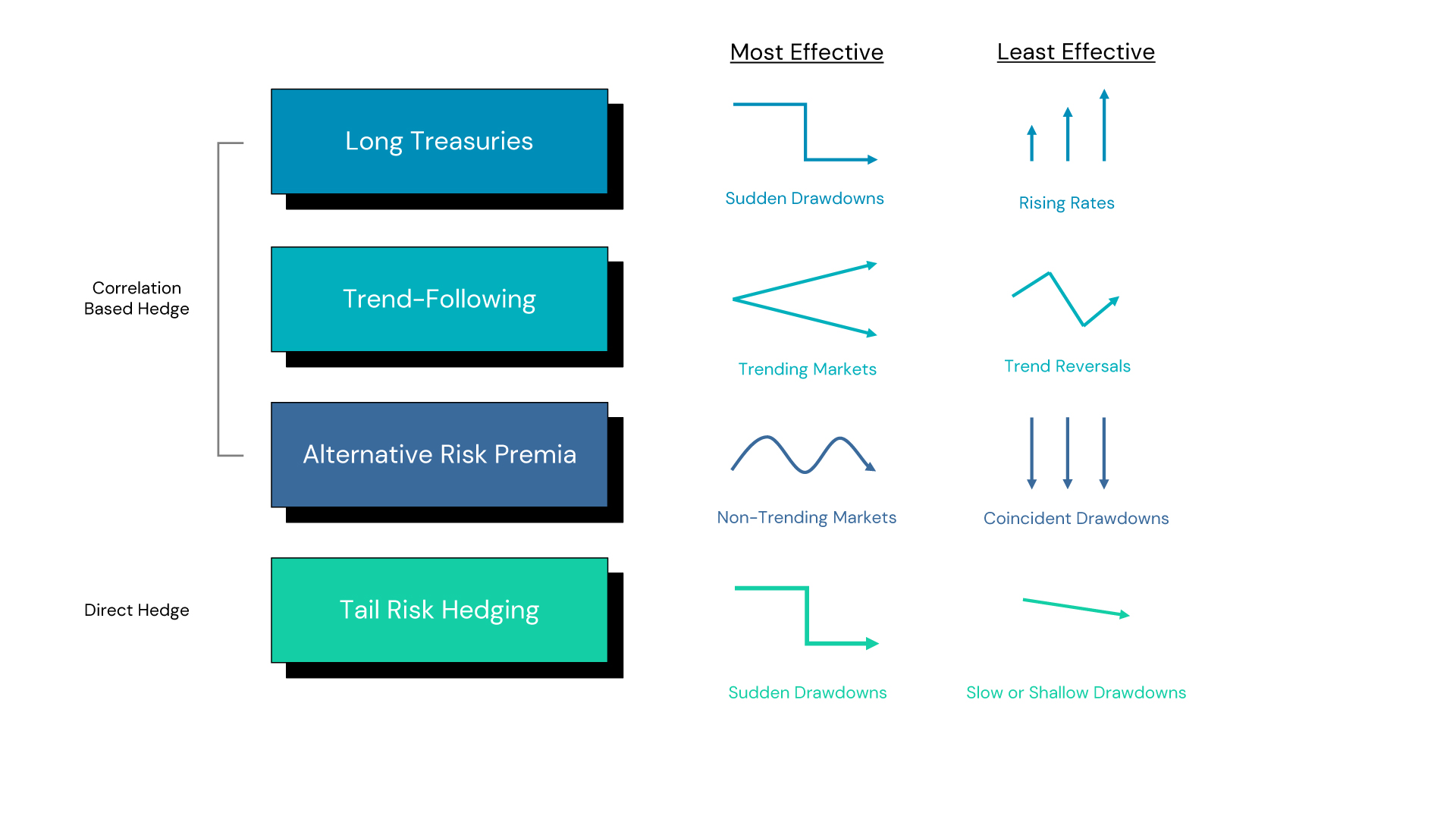
Source: PIMCO. For illustrative purposes only.
In an increasingly volatile investment landscape, the value of thoughtful, well-communicated diversification strategies cannot be overstated. When executed effectively, combining immediate responders, delayed responders, and diversifiers through return stacking may improve portfolio resilience while supporting long-term investment objectives.
Advisor Takeaways
- Immediate responders, delayed responders, and diversifiers serve distinct purposes and respond at different stages of equity drawdowns.
- Immediate responders—such as long volatility strategies—may react quickly during sharp market declines.
- Delayed responders, including managed futures and trend-following, often require sustained trends and may be more effective during prolonged downturns.
- Diversifiers—like market-neutral or relative value strategies—are generally uncorrelated with equities and may contribute returns during sideways or flat markets.
- Return stacking allows these strategies to be layered on top of traditional stock and bond allocations, helping to preserve core exposures.
- Different strategies may activate under different market conditions, and performance outcomes can vary based on the timing and nature of drawdowns.