
What’s the Optimal Stack?
Overview
The most common question we hear from advisors is what's the optimal stack? So we ran the optimizer — bootstrapping 10,000 simulated 25-year histories across five asset classes to find the portfolio that would have maximized return at 60/40 volatility. The answer is mathematically elegant and practically unusable.
In this piece, we walk through why the "optimal" portfolio would have been nearly impossible to stick with, how tracking error may serve as a better guide than portfolio efficiency, and why diversifying across multiple alternative strategies — rather than concentrating in one — has historically delivered comparable risk-adjusted returns with significantly less behavioral pain.
We also explore how different blending approaches (equal weight, inverse volatility, conviction-led, and objective-led) may serve different advisor needs, and why the same economic exposure can feel radically different depending on implementation.
The best stack isn't the one on the efficient frontier. It's the one your client can hold for 20 years.
Key Topics
Portfolio Construction, Optimal Stack, Objective-Based Stack Design
One question comes up in nearly every conversation we have with allocators evaluating return stacking: What’s the optimal stack?
It’s a fair question. If you’re going to layer diversifying exposure on top of a core portfolio, you want to know the right amount, the right blend, and the right implementation. You want the answer.
We have the answer. We ran the optimizer. And we’re going to share it with you.
But first, we need to talk about why you probably shouldn’t use it.
Want to skip the theory and get your hands dirty?
The Optimizer’s Answer
Before we get to stacking, let’s see what happens without any constraints. If we simply ask, “what portfolio maximizes return at the same volatility as a 60/40 stock/bond portfolio?”, what does the math say?
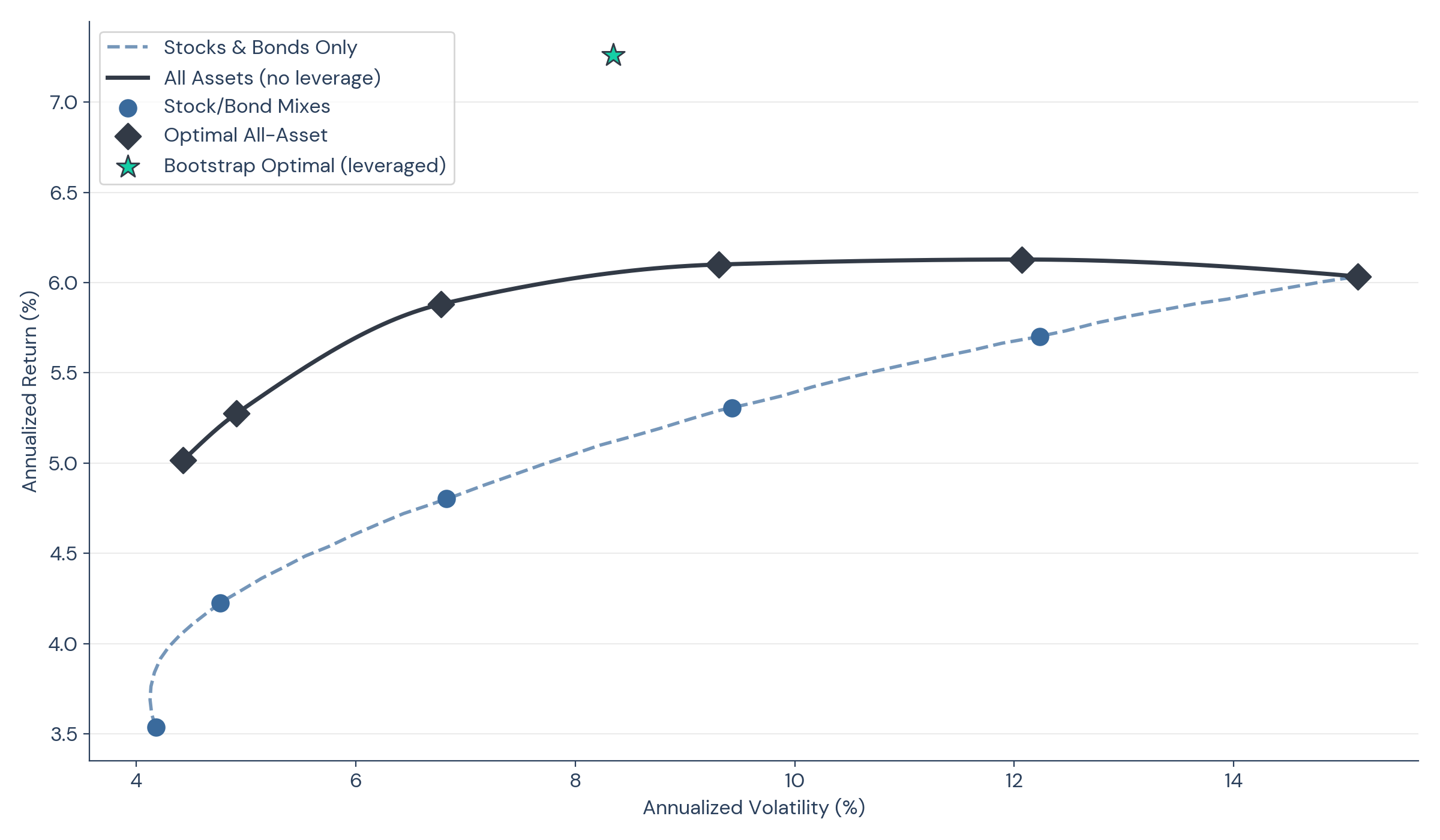
This is portfolio math 101: plot the efficient frontier, find the portfolio with the best risk-adjusted returns, and lever it to your desired volatility. When we expand the opportunity set beyond stocks and bonds, the frontier shifts upward even without leverage. At 60/40 volatility, the gap between the stock-and-bond frontier and the all-asset frontier represents the return that diversification alone can unlock. The bootstrap optimal point goes further, using leverage to push beyond what any unlevered portfolio can achieve.
To build this picture, we used a block bootstrap approach throughout. We took monthly returns for five asset classes (U.S. stocks, U.S. bonds, gold, managed futures, and merger arbitrage) over the period from January 2000 through December 2025.
Before bootstrapping, we adjusted each asset’s mean return so that its long-term Sharpe ratio reflects a conservative forward-looking assumption rather than the realized historical value. Historical Sharpe ratios over this period were unusually high for several asset classes, driven by favorable macro tailwinds, sample-specific mean reversion, and the general tendency for realized returns to exceed ex-ante risk premia over any finite sample. The adjustments preserve each asset’s historical volatility, correlations, and month-to-month return dynamics while producing more realistic expected return levels.
We then generated 10,000 simulated 25-year histories by resampling 12-month blocks of the adjusted returns, preserving the month-to-month relationships while scrambling the order. Every point in Figure 1 reports the median annualized return and mean volatility across all 10,000 simulations. For the bootstrap optimal point, we ran an optimizer within each simulation that maximized return at the same volatility as a 60/40 portfolio in that simulated world, with a financing cost of T-bills plus 50 basis points and a long-only constraint, then averaged the 10,000 optimal portfolios together.
By testing across many possible histories drawn from the same return environment, the result is more robust than fitting to a single path, but the allocations produced are no less extreme.
Data sources: Bloomberg (S&P 500, Bloomberg US Aggregate Bond Index, Bloomberg Short Treasury US Total Return Index, XAU/USD); PivotalPath (PivotalPath Managed Futures Index, PivotalPath Event Driven: Merger Arbitrage Index). Calculations by Return Stacked® Portfolio Solutions. U.S. Stocks is the S&P 500 Total Return Index. U.S. Bonds is the Bloomberg US Aggregate Bond Index. Gold is XAU/USD spot price. Managed Futures is the PivotalPath Managed Futures Index. Merger Arbitrage is the PivotalPath Event Driven: Merger Arbitrage Index. T-Bills is the Bloomberg Short Treasury US Total Return Index. All frontier points, reference portfolios, and the bootstrap optimal are computed using a block bootstrap of 10,000 simulated 25-year histories resampled from the monthly data. Return is the median annualized geometric return across simulations; volatility is the mean annualized standard deviation of monthly returns across simulations. The “Stocks & Bonds Only” frontier plots all long-only combinations of U.S. Stocks and U.S. Bonds. The “All Assets” frontier plots long-only allocations to all five asset classes with weights summing to 100% (no leverage). The 60/40 portfolio is 60% U.S. Stocks / 40% U.S. Bonds, rebalanced monthly. The Bootstrap Optimal portfolio is the average of 10,000 per-simulation optimizations that maximize geometric return at 60/40 volatility with leverage allowed; notional exposure exceeding 100% is financed at T-Bills plus 50 basis points annualized. January 2000 through December 2025. U.S. Stocks, U.S. Bonds, and T-Bills returns are gross of management fees, performance fees, and transaction costs and assume the reinvestment of all distributions. Gold returns reflect spot price changes only and are reduced by an estimated 40 basis point annual access fee. Managed Futures and Merger Arbitrage returns are reported net of management fees, performance fees, and underlying transaction costs. All returns are gross of taxes. Prior to bootstrapping, each asset’s mean return was adjusted to reflect a forward-looking Sharpe ratio assumption; historical volatilities, correlations, and return dynamics are preserved. Hypothetical backtested performance. Past performance is not indicative of future results. You cannot invest in an index.
Across the 10,000 simulated histories, the bootstrap-optimal portfolio produced a median return of 7.3% at a mean volatility of 8.3%, meaningfully above the 60/40’s 5.3% at 9.4% volatility. Similar risk, materially more return. While we use 60/40 as our reference throughout this analysis, the same bootstrap approach can be applied to any target-risk allocation—20/80, 40/60, 80/20, or anything in between.
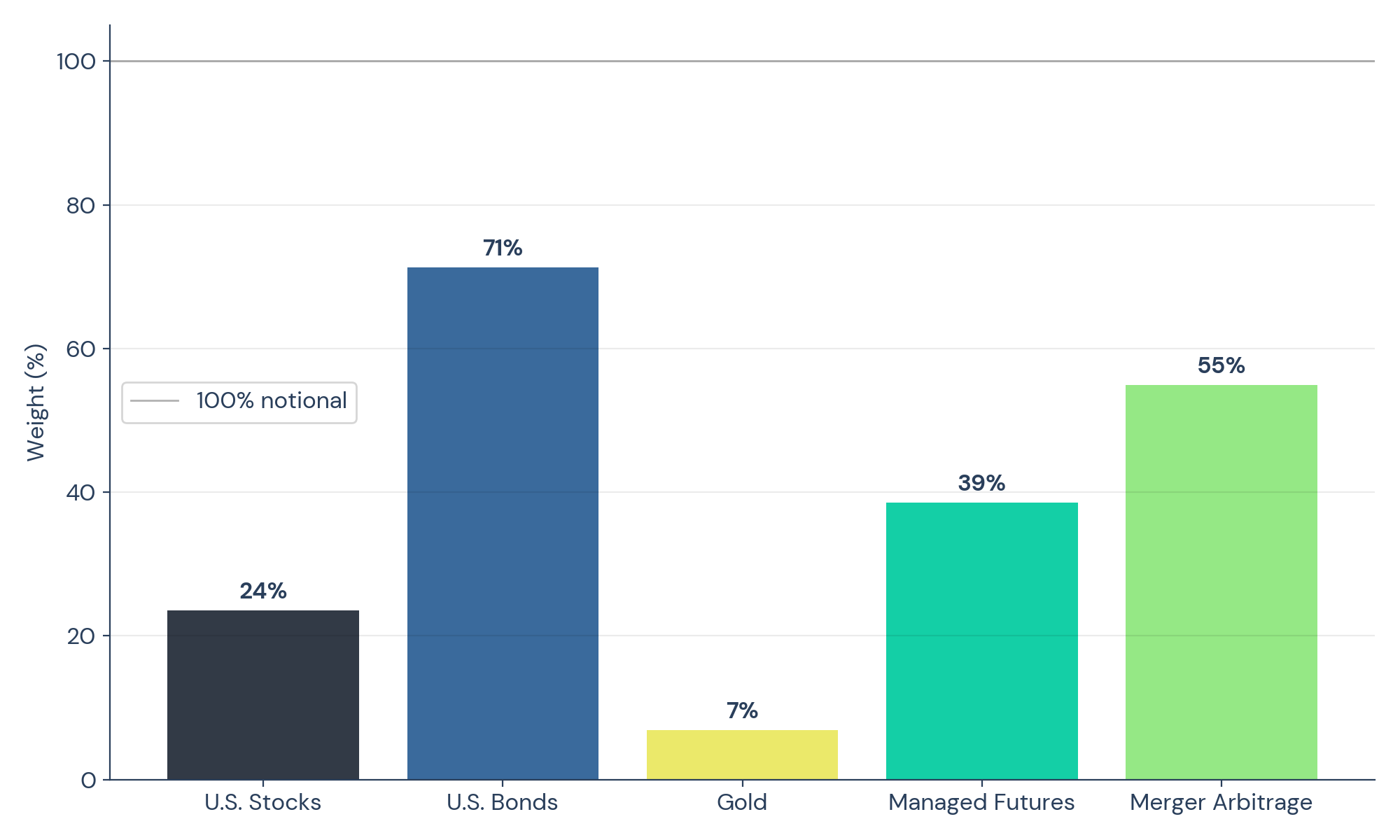
Here’s what that portfolio looks like:
Data sources: Bloomberg (S&P 500, Bloomberg US Aggregate Bond Index, Bloomberg Short Treasury US Total Return Index, XAU/USD); PivotalPath (PivotalPath Managed Futures Index, PivotalPath Event Driven: Merger Arbitrage Index). Calculations by Return Stacked® Portfolio Solutions. U.S. Stocks is the S&P 500 Total Return Index. U.S. Bonds is the Bloomberg US Aggregate Bond Index. Gold is XAU/USD spot price. Managed Futures is the PivotalPath Managed Futures Index. Merger Arbitrage is the PivotalPath Event Driven: Merger Arbitrage Index. T-Bills is the Bloomberg Short Treasury US Total Return Index. Hypothetical portfolio weights derived from bootstrap optimization of 10,000 simulated 25-year return histories using monthly index data from January 2000 through December 2025. For each simulation, the optimizer maximized geometric return at the same volatility as a 60/40 portfolio (60% U.S. Stocks / 40% U.S. Bonds, rebalanced monthly). Notional exposure exceeding 100% is financed at T-Bills plus 50 basis points annualized. U.S. Stocks, U.S. Bonds, and T-Bills returns are gross of management fees, performance fees, and transaction costs and assume the reinvestment of all distributions. Gold returns reflect spot price changes only and are reduced by an estimated 40 basis point annual access fee. Managed Futures and Merger Arbitrage returns are reported net of management fees, performance fees, and underlying transaction costs. All returns are gross of taxes. These results are backtested and hypothetical. Past performance is not indicative of future results. You cannot invest in an index.
Twenty-four percent in stocks. Seventy-one percent in bonds. Thirty-nine percent in managed futures. Fifty-five percent in merger arbitrage. Total notional exposure of 195%. This is the portfolio that, across thousands of simulated histories, consistently maximized return at 60/40 volatility.
Now imagine explaining this in a quarterly review.
This skepticism is understandable, but it often misses a crucial point: bond yields act like gravity for long-run returns (a point we’ll address specifically in the third section of this article). While recent returns may look weak, that backward-looking disappointment is largely a reflection of rising yields, which can be good news for future returns. In fact, bond returns often behave inversely to past performance. As yields rise, they drag present returns down but simultaneously lift forward-looking expectations. In many ways, all changing yields really do is push and pull returns across time. Interest rates, after all, govern the time value of money. When yields rise, they simply reallocate return from the present into the future, and when they fall, they pull some of that future return forward.
“Fixed income markets are currently offering forward-looking returns that are not only positive but unusually competitive relative to recent history.”
The Behavioral Roller Coaster
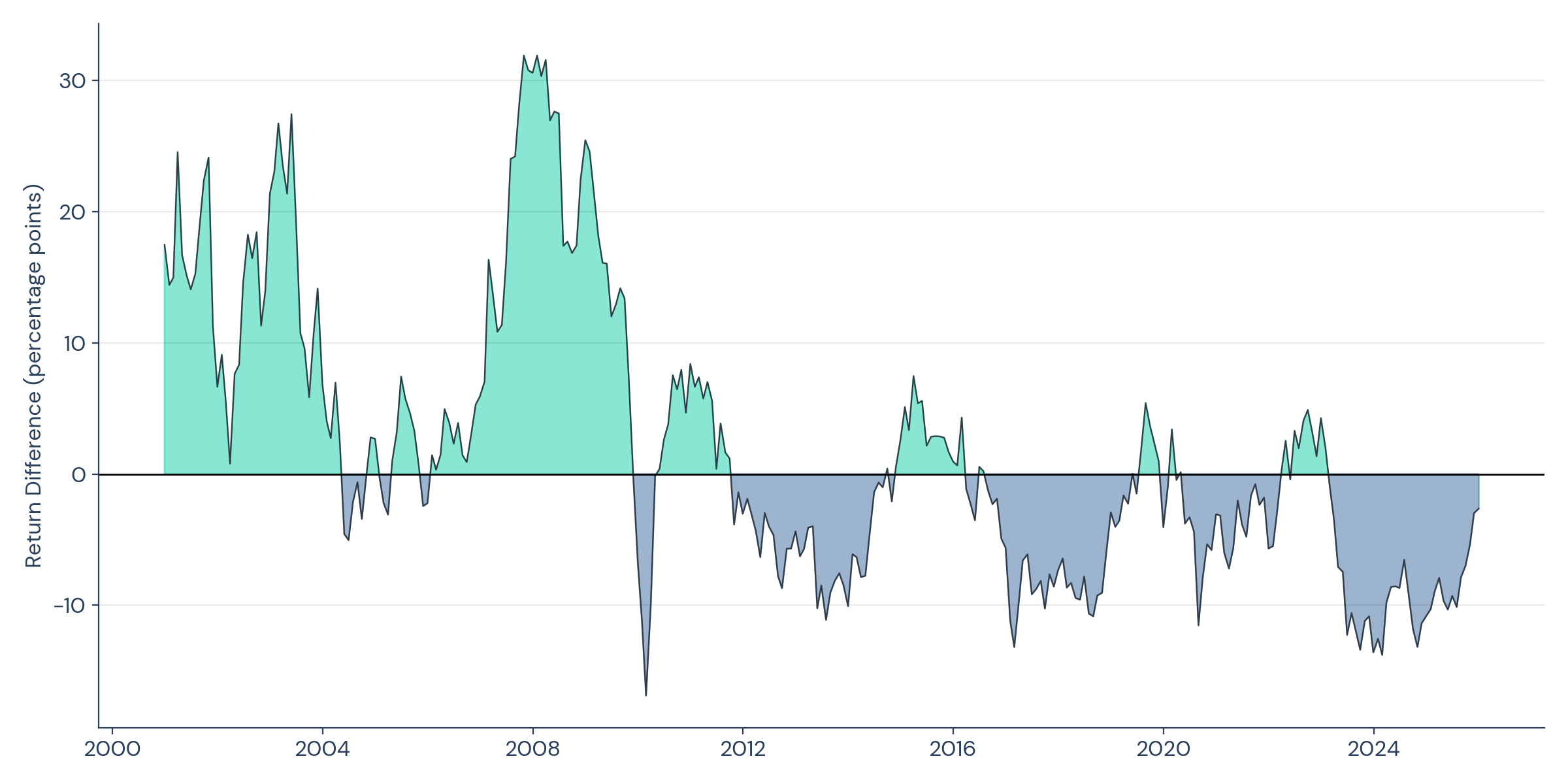
The optimal portfolio has a tracking error of 7.8% relative to a 60/40. To put that in context: over any given 12-month period, the return difference between this portfolio and a 60/40 ranged from −17 percentage points to +32 percentage points.
Data sources: Bloomberg (S&P 500, Bloomberg US Aggregate Bond Index, Bloomberg Short Treasury US Total Return Index, XAU/USD); PivotalPath (PivotalPath Managed Futures Index, PivotalPath Event Driven: Merger Arbitrage Index). Calculations by Return Stacked® Portfolio Solutions. U.S. Stocks is the S&P 500 Total Return Index. U.S. Bonds is the Bloomberg US Aggregate Bond Index. Gold is XAU/USD spot price. Managed Futures is the PivotalPath Managed Futures Index. Merger Arbitrage is the PivotalPath Event Driven: Merger Arbitrage Index. T-Bills is the Bloomberg Short Treasury US Total Return Index. The 60/40 portfolio is 60% U.S. Stocks / 40% U.S. Bonds, rebalanced monthly. The Optimal Portfolio is the bootstrap-optimal allocation of 24% U.S. Stocks, 71% U.S. Bonds, 7% Gold, 39% Managed Futures, and 55% Merger Arbitrage (195% total notional), rebalanced monthly; notional exceeding 100% is financed at T-Bills plus 50 basis points annualized. The figure shows the rolling 12-month return difference between the Optimal Portfolio and the 60/40 over the period January 2000 through December 2025. U.S. Stocks, U.S. Bonds, and T-Bills returns are gross of management fees, performance fees, and transaction costs and assume the reinvestment of all distributions. Gold returns reflect spot price changes only and are reduced by an estimated 40 basis point annual access fee. Managed Futures and Merger Arbitrage returns are reported net of management fees, performance fees, and underlying transaction costs. All returns are gross of taxes. Prior to bootstrapping, each asset’s mean return was adjusted to reflect a forward-looking Sharpe ratio assumption; historical volatilities, correlations, and return dynamics are preserved. Hypothetical backtested performance. Past performance is not indicative of future results. You cannot invest in an index.
In roughly half of all rolling 12-month windows, the optimal portfolio trailed a 60/40, and nearly one in three periods saw underperformance exceeding five percentage points. This underperformance often occurred precisely when the diversifiers were doing exactly what they were hired to do—complementing, while being entirely different from, the stock and bond allocation.
The chart tells the story. In periods where stocks struggled, the optimal portfolio’s underweight to equities was an enormous tailwind. When equities rallied, that same underweight became a persistent drag. The optimal portfolio essentially matched the 60/40 over the post-2009 bull market, holding only 24% in stocks during one of the greatest equity runs in history. Remarkable in one sense, but cold comfort in the quarterly review where the client watches their neighbor’s index fund pull ahead year after year.
This isn’t a portfolio construction failure. It’s the expected cost of being different. The optimal portfolio is different, and that’s what generates the excess return. But the same difference that drives long-term outperformance creates short-term experiences that most clients (and most allocators) would find intolerable.
The optimizer doesn’t know about client phone calls. It doesn’t model the very human tendency to abandon a strategy at the worst possible time. To paraphrase Cliff Asness, allocators plan in statistical time while clients live in behavioral time, which is closer to dog years. A three-year stretch of underperformance is a rounding error in a Monte Carlo simulation; it can feel like a lifetime in a quarterly review.
For most allocators, therefore, the question isn’t what’s optimal? The question is what’s optimal given the constraint that my client needs to stay invested?
“Allocators plan in statistical time while clients live in behavioral time, which is closer to dog years.”
From Optimal to Tolerable: Tracking Error as Your Guide
Most allocators don’t think in terms of tracking error, and that’s understandable; it’s an abstract metric. But it turns out to be one of the most useful frameworks for calibrating how much to stack.
Tracking error measures how much a portfolio’s returns deviate from a benchmark; in this case, the core stock/bond allocation the allocator would otherwise run. A higher tracking error means more frequent and more extreme periods where the stacked portfolio looks nothing like the benchmark. A lower tracking error means the stacked portfolio stays closer to home.
Traditional diversification is a process of addition through subtraction: to add alternatives, you must sell stocks or bonds, giving up expected return or stability to make room. Return stacking sidesteps that trade-off. It layers diversifiers on top of the existing strategic asset allocation (SAA) rather than carving out room for them within it. The SAA reflects the allocator’s core investment thesis: the equity/bond split that matches the client’s risk tolerance, time horizon, and goals. Reallocating from stocks or bonds to fund a diversifier position changes that thesis. Stacking preserves it. The diversifier overlay becomes the sole source of tracking error relative to the SAA.
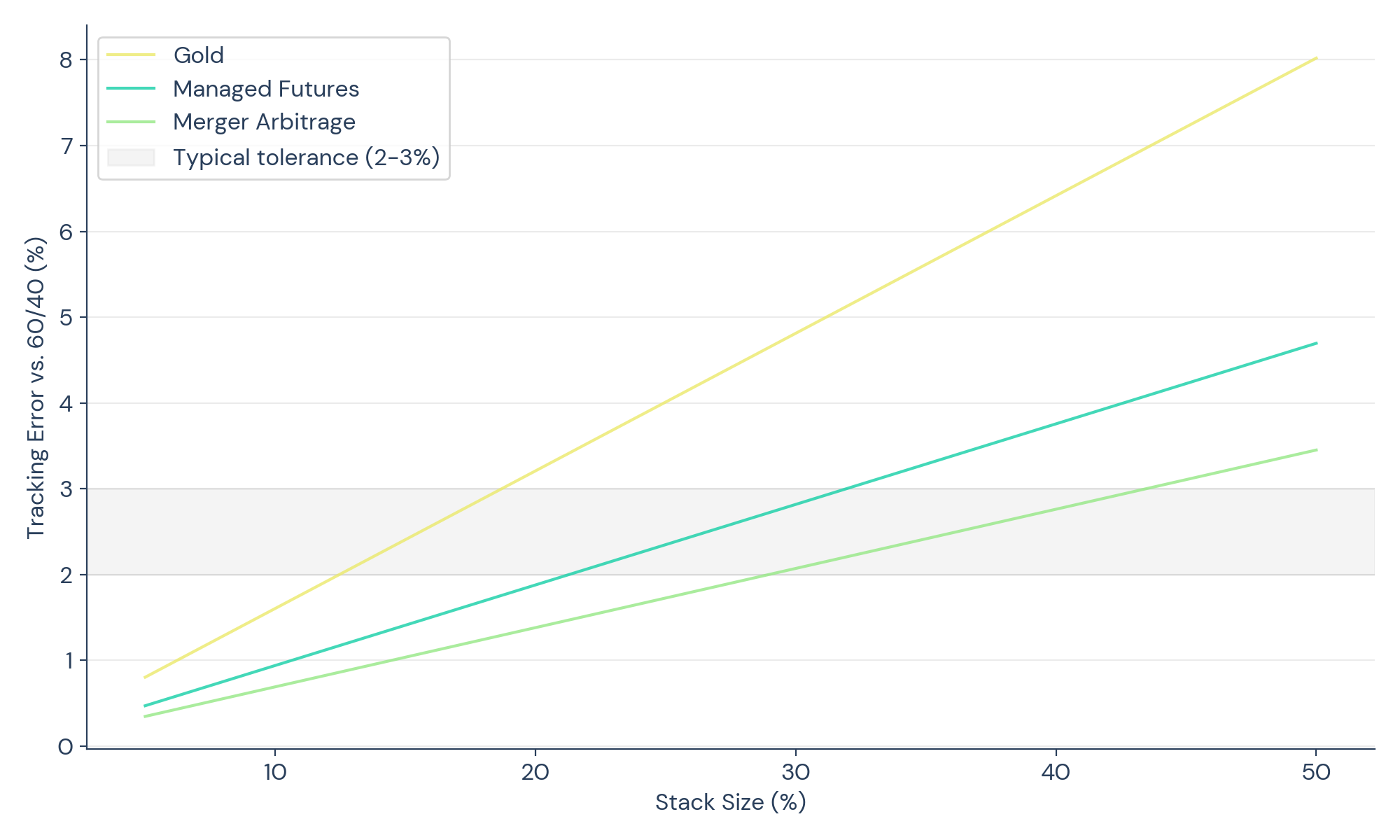
In our experience working with allocators, roughly 2–3% annualized tracking error is the upper bound of what most clients can tolerate over a full market cycle. Beyond that, the rolling return differences become large enough and persistent enough that clients start asking uncomfortable questions, often precisely when the diversifiers are doing exactly what we hired them to do.
Stacking on top of the SAA also simplifies measurement. Because the stack is the only change to the base allocation, the volatility of the stack (scaled by its size) approximates the tracking error contribution from return stacking alone. In practice, most allocators also have active security selection and other deviations from their pure SAA targets, which contribute their own tracking error. But the volatility of the stack gives allocators a straightforward way to estimate how much incremental tracking error the return-stacking decision alone is adding.
What does that translate to in stack size? It depends on what you’re stacking.
Data sources: Bloomberg (S&P 500, Bloomberg US Aggregate Bond Index, Bloomberg Short Treasury US Total Return Index, XAU/USD); PivotalPath (PivotalPath Managed Futures Index, PivotalPath Event Driven: Merger Arbitrage Index). Calculations by Return Stacked® Portfolio Solutions. U.S. Stocks is the S&P 500 Total Return Index. U.S. Bonds is the Bloomberg US Aggregate Bond Index. Gold is XAU/USD spot price. Managed Futures is the PivotalPath Managed Futures Index. Merger Arbitrage is the PivotalPath Event Driven: Merger Arbitrage Index. T-Bills is the Bloomberg Short Treasury US Total Return Index. The 60/40 portfolio is 60% U.S. Stocks / 40% U.S. Bonds, rebalanced monthly. Tracking error is calculated as the annualized standard deviation of the monthly return difference between the stacked portfolio and the 60/40, using historical monthly returns from January 2000 through December 2025. Diversifier exposure represents leveraged notional above the fully-invested base portfolio; each unit of diversifier exposure is financed at T-Bills plus 50 basis points annualized. U.S. Stocks, U.S. Bonds, and T-Bills returns are gross of management fees, performance fees, and transaction costs and assume the reinvestment of all distributions. Gold returns reflect spot price changes only and are reduced by an estimated 40 basis point annual access fee. Managed Futures and Merger Arbitrage returns are reported net of management fees, performance fees, and underlying transaction costs. All returns are gross of taxes. Past performance is not indicative of future results. You cannot invest in an index.
The chart shows the tracking error generated by different individual diversifiers at various stack sizes. The key observation: diversifiers with higher standalone volatility generate more tracking error per unit of stack. Gold, with an annualized volatility of 16%, hits the 2% tracking error threshold at roughly a 12% stack size. Merger arbitrage, at 7% volatility, doesn’t reach 2% tracking error until nearly 28%.
This has a practical implication that is easy to overlook: at small stack sizes, you need higher-volatility diversifiers to make a meaningful difference. A 5% allocation to merger arbitrage generates roughly 0.3% of tracking error, barely distinguishable from noise. That same 5% in gold generates roughly 0.8%. Neither is likely to materially improve portfolio outcomes.
So far we’ve looked at each diversifier in isolation. The picture changes when you blend them.
"At small stack sizes, you need higher-volatility diversifiers to make a meaningful difference."
Diversify Your Diversifiers
It should come as no surprise that diversification works on diversifiers, too.
Consider what happens when we blend diversifiers rather than concentrate in one. Using the same block bootstrap (10,000 simulated 25-year histories), here are the statistics for each blending approach at a 20% stack on a 60/40, averaged across all paths:
| Approach | Active Return | Information Ratio | Worst 12m | Tracking Error |
|---|---|---|---|---|
| Equal Weight (all three) | 0.60% | 0.41 | −2.4% | 1.47% |
| Inverse Volatility Weighted | 0.58% | 0.47 | −1.9% | 1.23% |
| MF Only | 0.61% | 0.32 | −3.5% | 1.88% |
| Gold Only | 0.57% | 0.18 | −6.8% | 3.20% |
| Merger Arb Only | 0.62% | 0.45 | −2.7% | 1.38% |
Data sources: Bloomberg (S&P 500, Bloomberg US Aggregate Bond Index, Bloomberg Short Treasury US Total Return Index, XAU/USD); PivotalPath (PivotalPath Managed Futures Index, PivotalPath Event Driven: Merger Arbitrage Index). Calculations by Return Stacked® Portfolio Solutions. U.S. Stocks is the S&P 500 Total Return Index. U.S. Bonds is the Bloomberg US Aggregate Bond Index. Gold is XAU/USD spot price. Managed Futures is the PivotalPath Managed Futures Index. Merger Arbitrage is the PivotalPath Event Driven: Merger Arbitrage Index. T-Bills is the Bloomberg Short Treasury US Total Return Index. The 60/40 portfolio is 60% U.S. Stocks / 40% U.S. Bonds, rebalanced monthly. Statistics are measured across 10,000 block-bootstrap simulated 25-year histories at a 20% stack on the 60/40. Active Return is the median annualized arithmetic mean of the monthly return difference between the stacked portfolio and the 60/40. Tracking Error is the mean annualized standard deviation of the monthly return difference between the stacked portfolio and the 60/40. Information Ratio is Active Return divided by Tracking Error. Worst 12m is the mean worst rolling 12-month return difference between the stacked portfolio and the 60/40 across all simulations. The Inverse Volatility Weighted approach computes weights monthly using trailing 36-month annualized volatility; the first 36 months of each simulation serve as a burn-in period and all approaches are evaluated over the same post-burn-in window for comparability. Diversifier exposure represents leveraged notional above the fully-invested base portfolio; each unit of diversifier exposure is financed at T-Bills plus 50 basis points annualized. U.S. Stocks, U.S. Bonds, and T-Bills returns are gross of management fees, performance fees, and transaction costs and assume the reinvestment of all distributions. Gold returns reflect spot price changes only and are reduced by an estimated 40 basis point annual access fee. Managed Futures and Merger Arbitrage returns are reported net of management fees, performance fees, and underlying transaction costs. All returns are gross of taxes. Prior to bootstrapping, each asset’s mean return was adjusted to reflect a forward-looking Sharpe ratio assumption; historical volatilities, correlations, and return dynamics are preserved. Hypothetical backtested performance. Past performance is not indicative of future results. You cannot invest in an index.
The diversified blends deliver information ratios (active return per unit of tracking error — a measure of how efficiently a strategy converts its deviation from the benchmark into excess return) comparable to the best single-diversifier approach, without requiring the allocator to identify that best approach in advance. The Inverse Volatility Weighted approach’s information ratio of 0.47 is close to merger arbitrage’s 0.45, but achieved through diversification rather than a concentrated bet. This matters because the best single-diversifier approach is not obvious ex ante and varies across simulated histories.
More importantly, look at the worst rolling 12-month return difference. The Inverse Volatility Weighted approach’s average worst-case 12-month shortfall was just 1.9 percentage points. The single-diversifier approaches had average worst-case shortfalls of 2.7–6.8 percentage points.
The reason is straightforward. These diversifiers have low correlations with each other, not just with stocks and bonds. When gold zigs, managed futures may zag. The diversification benefit that makes alternatives attractive relative to a core portfolio also makes blending alternatives attractive relative to concentrating in one.
"These diversifiers have low correlations with each other, not just with stocks and bonds."
Single-diversifier stacks are not wrong, but they require more behavioral tolerance from both the allocator and the client. This is one reason we see most allocators landing between 10% and 25% total stack, using two to three diversifiers.
Diversification also enables a larger stack within the same tracking error budget. Because blended diversifiers generate less tracking error per unit of stack, an allocator constrained to 2% tracking error can allocate meaningfully more to a diversified blend than to any single diversifier. The same behavioral tolerance that limits single-diversifier stacks to 10–15% may permit a blended stack of 20–25%.
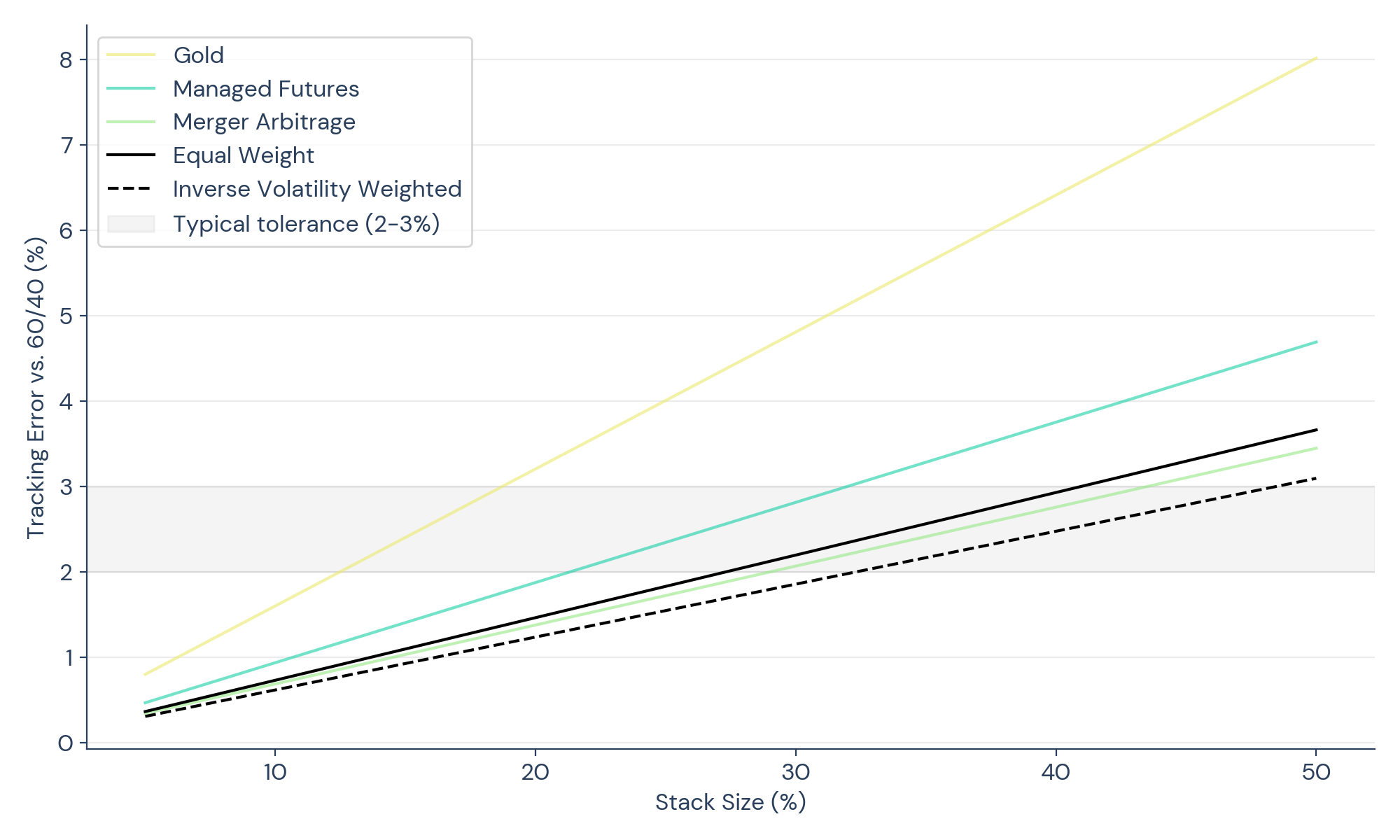
Data sources: Bloomberg (S&P 500, Bloomberg US Aggregate Bond Index, Bloomberg Short Treasury US Total Return Index, XAU/USD); PivotalPath (PivotalPath Managed Futures Index, PivotalPath Event Driven: Merger Arbitrage Index). Calculations by Return Stacked® Portfolio Solutions. U.S. Stocks is the S&P 500 Total Return Index. U.S. Bonds is the Bloomberg US Aggregate Bond Index. Gold is XAU/USD spot price. Managed Futures is the PivotalPath Managed Futures Index. Merger Arbitrage is the PivotalPath Event Driven: Merger Arbitrage Index. T-Bills is the Bloomberg Short Treasury US Total Return Index. The 60/40 portfolio is 60% U.S. Stocks / 40% U.S. Bonds, rebalanced monthly. Tracking error is calculated as the annualized standard deviation of the monthly return difference between the stacked portfolio and the 60/40, using historical monthly returns from January 2000 through December 2025. The Equal Weight blend allocates equally across all three diversifiers. The Inverse Volatility Weighted approach weights each diversifier inversely proportional to its annualized volatility estimated from the trailing 36 months of returns; weights are updated monthly. Diversifier exposure represents leveraged notional above the fully-invested base portfolio; each unit of diversifier exposure is financed at T-Bills plus 50 basis points annualized. U.S. Stocks, U.S. Bonds, and T-Bills returns are gross of management fees, performance fees, and transaction costs and assume the reinvestment of all distributions. Gold returns reflect spot price changes only and are reduced by an estimated 40 basis point annual access fee. Managed Futures and Merger Arbitrage returns are reported net of management fees, performance fees, and underlying transaction costs. All returns are gross of taxes. Past performance is not indicative of future results. You cannot invest in an index.
Implementation
Given the benefits of blending, the next question is how. There are several reasonable approaches, and the right one depends on the allocator’s objectives and convictions.
Equal Weight
The simplest approach: allocate equally across your chosen diversifiers. It’s easy to explain, easy to implement, and historically has produced solid results. Equal weighting implicitly tilts toward higher-volatility diversifiers (gold gets as much weight as merger arbitrage despite having more than twice the volatility), which can introduce more tracking error.
Risk Weighted (Inverse Volatility)
Allocate more to lower-volatility diversifiers and less to higher-volatility ones, so that each diversifier contributes roughly equal risk to the stack. Weights are computed using each diversifier’s trailing 36-month volatility and updated monthly, avoiding any reliance on future data. In this dataset, inverse volatility weighting tilts toward merger arbitrage and away from gold.
An interesting comparison: at a 20% stack, the Inverse Volatility Weighted approach generates 1.23% tracking error versus 1.47% for Equal Weight. To match the Equal Weight tracking error, the Inverse Volatility Weighted approach can size up to roughly 24%, generating slightly more active return (0.76% versus 0.62%) at the same level of tracking error. In other words, the more risk-efficient blend buys you a modestly larger stack at the same behavioral cost.
Conviction Led
Not every allocator has the same view on every diversifier. Some may have deep conviction in trend following and view it as a core holding. Others may be skeptical of managed futures but comfortable with gold. The conviction-led approach simply says: weight what you believe in most heavily.
The trade-off is concentration. Single-diversifier stacks have historically produced lower information ratios and wider return swings. An allocator who dedicates their entire stack to managed futures needs to be comfortable explaining a nearly 5 percentage point shortfall relative to a 60/40 in the worst 12-month period.
Objective Led
Different diversifiers serve different roles in a portfolio, and the blend can be tailored to the allocator’s primary objective. To make this concrete, we ran our block bootstrap optimizer with two different objectives, both at a 20% stack on a 60/40 with a 2% tracking error constraint:
Consistent return: This objective balances the level of excess return with the consistency of that return, measured by the percentage of rolling 12-month windows where the stacked portfolio outperforms the base. The optimizer lands on a blend of 21% gold, 38% managed futures, 41% merger arbitrage. Remember, these are weights within the 20% stack. In terms of total portfolio allocation, that translates to 4.3% gold, 7.5% managed futures, and 8.2% merger arbitrage layered on top of the 60/40. This blend added a median of 0.85 percentage points of annualized return to the 60/40, was positive relative to the benchmark in 71% of rolling 12-month windows, and improved the 60/40’s max drawdown by 1.4 percentage points on average.
Crisis protection: The optimizer focused on minimizing the total portfolio’s maximum drawdown lands on a radically different answer: 4% gold, 95% managed futures, 2% merger arbitrage. In portfolio terms: 0.8% gold, 18.9% managed futures, and 0.3% merger arbitrage. This blend improved the 60/40’s max drawdown by 3.4 percentage points on average, but at a cost. The median excess return was only 0.66 percentage points, and the blend was positive in just 61% of 12-month windows.
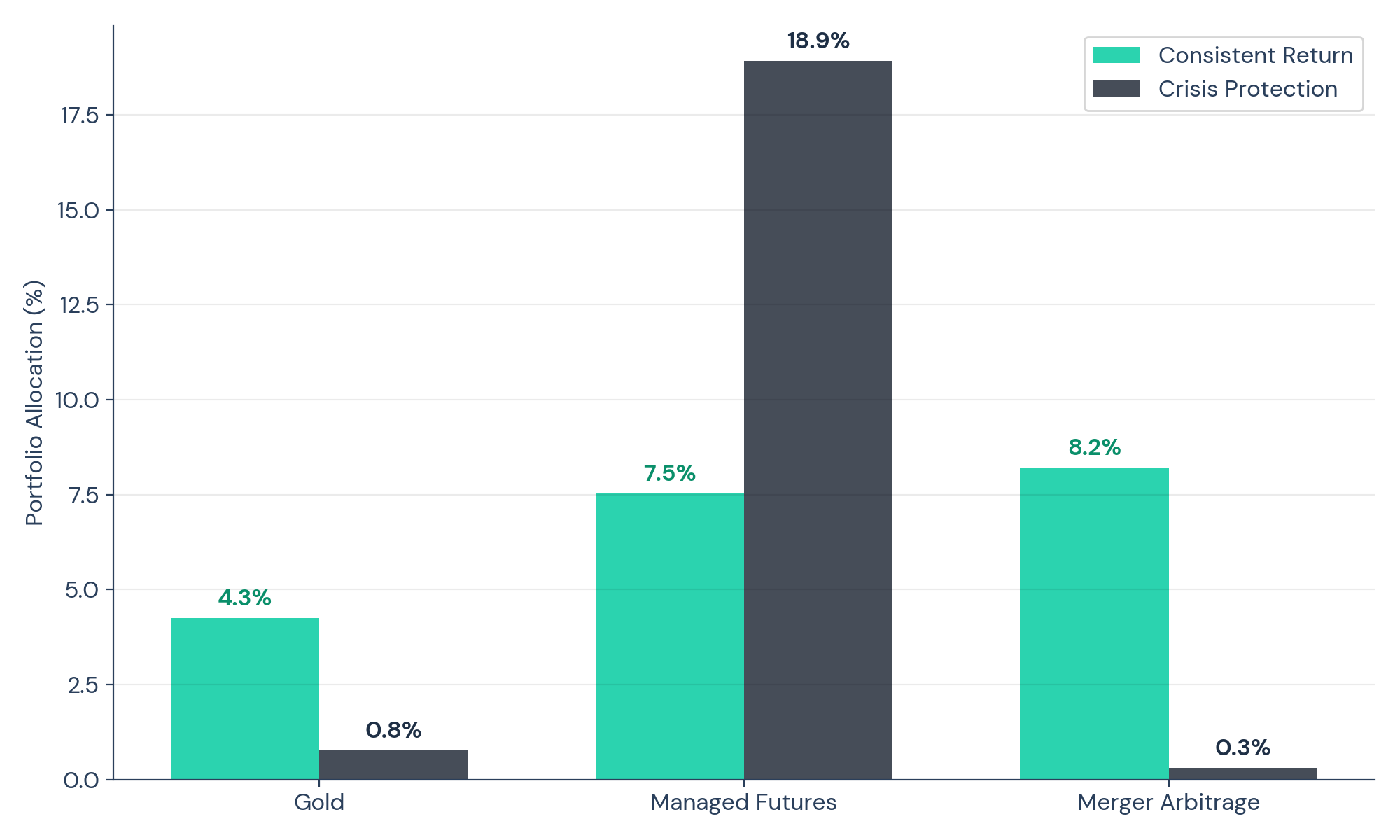
Data sources: Bloomberg (S&P 500, Bloomberg US Aggregate Bond Index, Bloomberg Short Treasury US Total Return Index, XAU/USD); PivotalPath (PivotalPath Managed Futures Index, PivotalPath Event Driven: Merger Arbitrage Index). Calculations by Return Stacked® Portfolio Solutions. U.S. Stocks is the S&P 500 Total Return Index. U.S. Bonds is the Bloomberg US Aggregate Bond Index. Gold is XAU/USD spot price. Managed Futures is the PivotalPath Managed Futures Index. Merger Arbitrage is the PivotalPath Event Driven: Merger Arbitrage Index. T-Bills is the Bloomberg Short Treasury US Total Return Index. The 60/40 portfolio is 60% U.S. Stocks / 40% U.S. Bonds, rebalanced monthly. Weights shown are averages across 10,000 block-bootstrap simulated 25-year histories, optimized at a 20% stack on the 60/40 with a 2% annualized tracking error constraint. The “Consistent Return” objective scores each candidate blend using a 50/50 combination of normalized median excess geometric return and normalized percentage of positive rolling 12-month periods, selecting the blend that best balances the level and consistency of excess return. The “Crisis Protection” objective minimizes the maximum peak-to-trough drawdown of the stacked portfolio. Diversifier exposure represents leveraged notional above the fully-invested base portfolio; each unit of diversifier exposure is financed at T-Bills plus 50 basis points annualized. U.S. Stocks, U.S. Bonds, and T-Bills returns are gross of management fees, performance fees, and transaction costs and assume the reinvestment of all distributions. Gold returns reflect spot price changes only and are reduced by an estimated 40 basis point annual access fee. Managed Futures and Merger Arbitrage returns are reported net of management fees, performance fees, and underlying transaction costs. All returns are gross of taxes. Prior to bootstrapping, each asset’s mean return was adjusted to reflect a forward-looking Sharpe ratio assumption; historical volatilities, correlations, and return dynamics are preserved. Hypothetical backtested performance. Past performance is not indicative of future results. You cannot invest in an index.
The contrast is striking. The consistent return blend diversifies across all three asset classes, tilting toward merger arbitrage for its steady excess returns and gold for its uncorrelated profile, while the crisis protection blend concentrates almost entirely in managed futures. The reason lies in the characteristics of each diversifier:
| Gold | Managed Futures | Merger Arbitrage | |
|---|---|---|---|
| Excess Return over Financing | 3.2% | 2.8% | 3.4% |
| Volatility | 16.0% | 9.4% | 6.9% |
| Correlation to Stocks | 0.06 | −0.16 | 0.31 |
| Median Max Underwater vs. Financing | 12.5 years | 8.3 years | 7.5 years |
| Role | Store of value / inflation hedge | Regime resilience | Consistent excess return |
Data sources: Bloomberg (XAU/USD); PivotalPath (PivotalPath Managed Futures Index, PivotalPath Event Driven: Merger Arbitrage Index). Calculations by Return Stacked® Portfolio Solutions. Gold is XAU/USD spot price. Managed Futures is the PivotalPath Managed Futures Index. Merger Arbitrage is the PivotalPath Event Driven: Merger Arbitrage Index. T-Bills is the Bloomberg Short Treasury US Total Return Index. Statistics are measured across 10,000 block-bootstrap simulated 25-year histories. Returns are quoted in excess of financing (T-Bills plus 50 basis points annualized). Correlations are measured against U.S. Stocks (S&P 500 Total Return Index). Median Max Underwater vs. Financing is the median length of the longest period during which the diversifier’s cumulative excess return over financing remained below its prior peak. Gold returns reflect spot price changes only and are reduced by an estimated 40 basis point annual access fee. Managed Futures and Merger Arbitrage returns are reported net of management fees, performance fees, and underlying transaction costs. All returns are gross of taxes. Prior to bootstrapping, each asset’s mean return was adjusted to reflect a forward-looking Sharpe ratio assumption; historical volatilities, correlations, and return dynamics are preserved. Hypothetical backtested performance. Past performance is not indicative of future results. You cannot invest in an index.
It may be useful to think of diversifiers as falling into two camps: defense and offense. Managed futures and (to a lesser extent) gold have historically exhibited low or negative correlation to equities; their greatest value may show up when stocks and bonds are most vulnerable. But defense can come at a cost: both have historically spent years underperforming their financing, with median max underwater periods of 8 to 12+ years over the period studied. This measures how long you might wait for the diversifier to justify its financing cost—a proxy for how long you need to keep your nerve. Merger arbitrage, which has historically acted as a more offensive diversifier, has offered more consistent excess returns with lower volatility, but has tended to provide less crisis protection due to its positive equity correlation.
The optimizer reflects this trade-off directly. The consistent return blend diversifies across offense and defense, weighting toward merger arbitrage and gold for their reliable return contribution. The crisis protection blend concentrates almost entirely in managed futures, the purest defensive diversifier. If your goal is resilience, you need the asset that zigs when stocks zag. If your goal is consistent excess return, you want a broader mix that includes the steady earners.
Most allocators want elements of both. An objective-led allocator might weight toward managed futures if the primary goal is crisis protection, toward merger arbitrage and gold if the goal is consistent return enhancement, or blend all three, which is effectively what the equal-weight and inverse-volatility approaches do by default.
The trade-offs between these approaches are hard to reason about in the abstract. We built a tool that lets you run this analysis with your own inputs—your base allocation, your diversifier preferences, and your tracking error tolerance.
Same Stack, Different Experience
The same economic exposure can look very different depending on how it’s implemented.
Consider an allocator who wants to stack 20% managed futures on a 60/40 portfolio. The aggregate exposure is the same regardless of implementation: 60% stocks, 40% bonds, 20% managed futures (less financing). But the allocator has choices about how to implement that stack.
Option A uses a stocks-plus-managed-futures fund. The allocator holds 40% in stocks, 40% in bonds, and 20% in the stacked fund. The stacked fund itself provides 20% exposure to both stocks and managed futures.
Option B uses a bonds-plus-managed-futures fund. The allocator holds 60% in stocks, 20% in bonds, and 20% in the stacked fund. Same aggregate exposure, different line items.
The portfolio-level returns are identical to eight decimal places. But the fund-level experience is not. The figures below plot the rolling 12-month returns and drawdowns of each fund. While both include identical managed futures allocations, they yield starkly different results because of their stock or bond components.
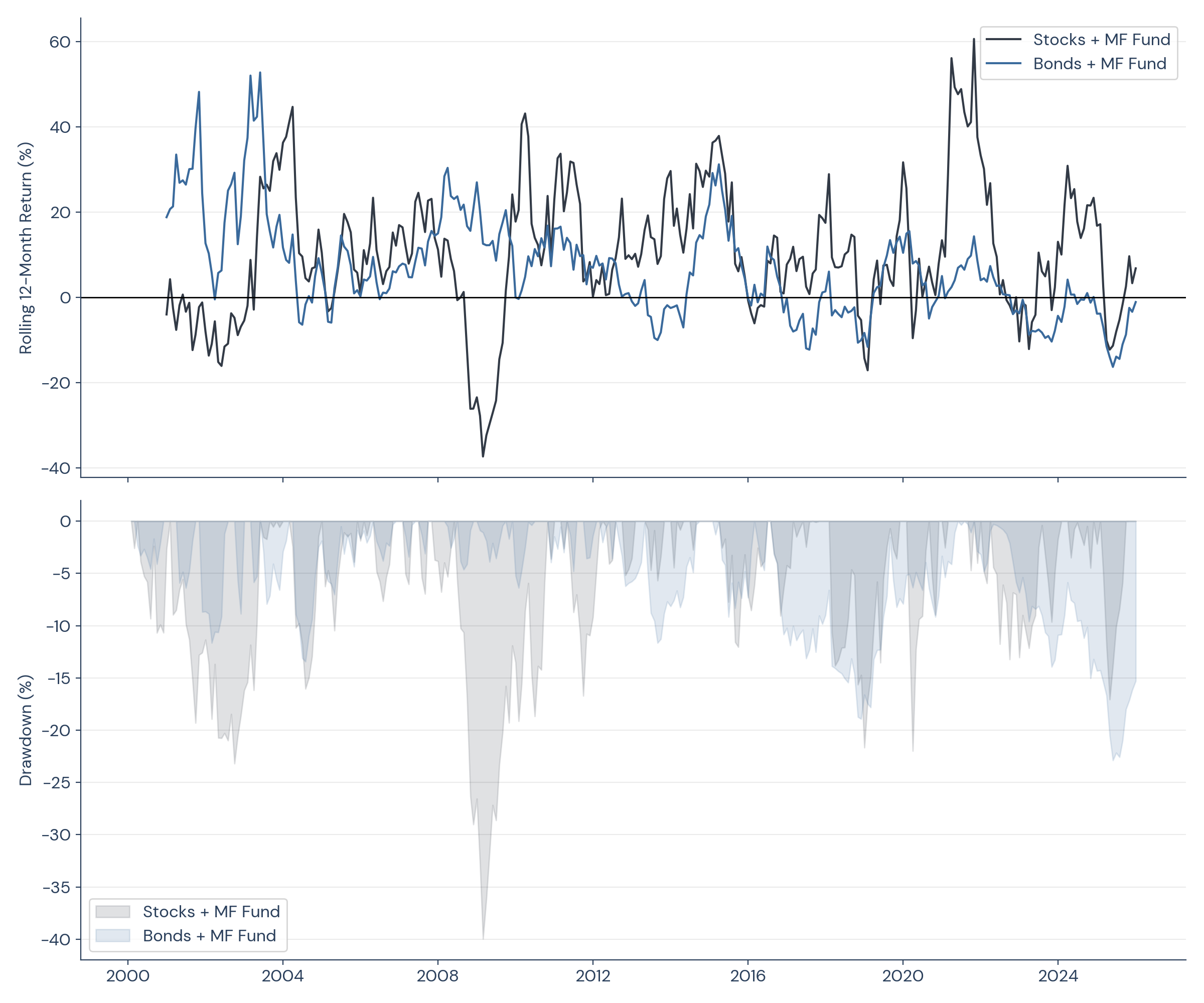
Data sources: Bloomberg (S&P 500, Bloomberg US Aggregate Bond Index, Bloomberg Short Treasury US Total Return Index); PivotalPath (PivotalPath Managed Futures Index). Calculations by Return Stacked® Portfolio Solutions. U.S. Stocks is the S&P 500 Total Return Index. U.S. Bonds is the Bloomberg US Aggregate Bond Index. Managed Futures is the PivotalPath Managed Futures Index. T-Bills is the Bloomberg Short Treasury US Total Return Index. The “Stocks + MF Fund” is a hypothetical fund providing 100% U.S. Stocks exposure and 100% notional Managed Futures exposure; the “Bonds + MF Fund” provides 100% U.S. Bonds exposure and 100% notional Managed Futures exposure. Managed Futures exposure is financed at T-Bills plus 50 basis points annualized. Both funds are rebalanced monthly. Hypothetical backtested performance, January 2000 through December 2025. U.S. Stocks, U.S. Bonds, and T-Bills returns are gross of management fees, performance fees, and transaction costs and assume the reinvestment of all distributions. Managed Futures returns are reported net of management fees, performance fees, and underlying transaction costs. All returns are gross of taxes. No additional fund-level expenses are modeled. Past performance is not indicative of future results. You cannot invest in an index.
The stocks-plus-managed-futures fund has an annualized volatility of 16.4%, compared to 15.1% for U.S. stocks alone. The bonds-plus-managed-futures fund: 10.6%, compared to 4.2% for U.S. bonds alone. To a client reviewing a statement, replacing equities with equities-plus-managed-futures barely registers. Replacing bonds with bonds-plus-managed-futures looks like it took a safe, stable allocation and made it volatile.
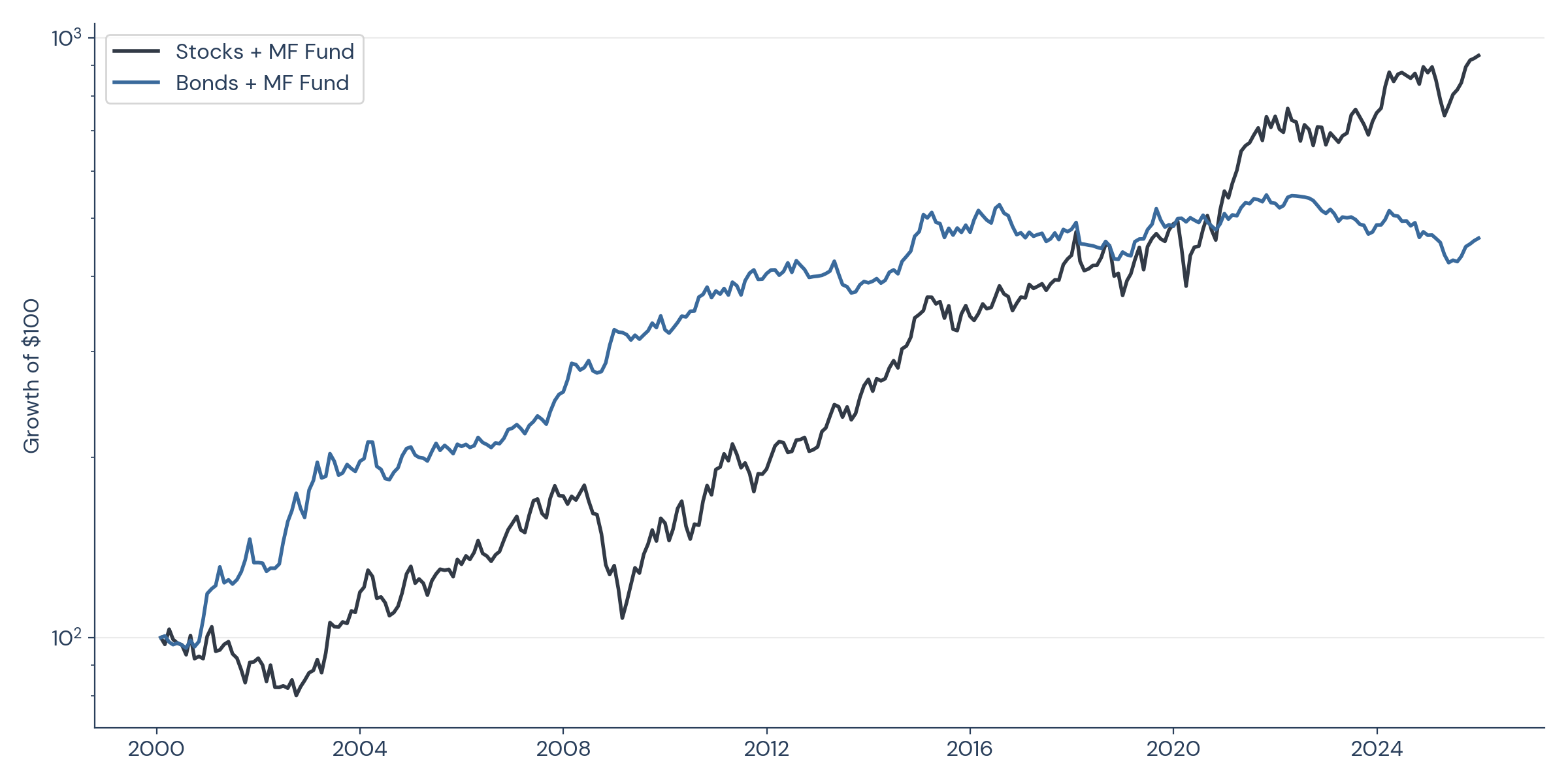
Data sources: Bloomberg (S&P 500, Bloomberg US Aggregate Bond Index, Bloomberg Short Treasury US Total Return Index); PivotalPath (PivotalPath Managed Futures Index). Calculations by Return Stacked® Portfolio Solutions. U.S. Stocks is the S&P 500 Total Return Index. U.S. Bonds is the Bloomberg US Aggregate Bond Index. Managed Futures is the PivotalPath Managed Futures Index. T-Bills is the Bloomberg Short Treasury US Total Return Index. The “Stocks + MF Fund” provides 100% U.S. Stocks exposure and 100% notional Managed Futures exposure; the “Bonds + MF Fund” provides 100% U.S. Bonds exposure and 100% notional Managed Futures exposure. Managed Futures exposure is financed at T-Bills plus 50 basis points annualized. Both funds are rebalanced monthly. Both funds produce identical aggregate portfolio returns when combined with the appropriate stock/bond holdings. Hypothetical backtested performance, January 2000 through December 2025. U.S. Stocks, U.S. Bonds, and T-Bills returns are gross of management fees, performance fees, and transaction costs and assume the reinvestment of all distributions. Managed Futures returns are reported net of management fees, performance fees, and underlying transaction costs. All returns are gross of taxes. No additional fund-level expenses are modeled. Past performance is not indicative of future results. You cannot invest in an index.
The choice between them isn’t about economics; it’s about which line-item experience the allocator and client are most comfortable seeing on a statement. Some allocators prefer the simplicity of replacing a portion of their equity allocation with a stocks-plus-alternatives fund. Others prefer the lower-volatility profile of the bonds-based implementation. Others split between both.
That asymmetry becomes especially visible when the magnitude of one component swamps the other. If stocks fall sharply and the alternative rallies, a stocks-plus-alternatives fund may still be moderately down while a bonds-plus-alternatives fund may be meaningfully up. If stocks rally and the alternative lags, the stocks-based fund may still be positive (though trailing) while the bonds-based fund may be flat or negative. Same stack, same portfolio-level impact, but very different line-item experiences. Clients tend to tolerate relative underperformance when returns are positive, while negative absolute returns on any line item trigger real discomfort.
Splitting the stack across two funds can reduce this friction. A 10% allocation to a stocks-plus-alternatives fund and a 10% allocation to a bonds-plus-alternatives fund achieves the same aggregate exposure while keeping individual positions at more manageable sizes. Smaller line items often draw less scrutiny, are easier to explain, and give the strategy more room to work over a full cycle.
None of these choices are wrong. They are behavioral choices, not mathematical ones.
"Clients tend to tolerate relative underperformance when returns are positive, while negative absolute returns on any line item trigger real discomfort."
Finding the Middle Path
Return stacking is not an optimization problem. It is a portfolio construction problem, and portfolio construction has to account for the human beings who actually own the portfolio.
The unconstrained optimizer produces a portfolio no one would actually hold. Even the constrained optimizer, after bootstrapping across thousands of simulated histories, produces answers remarkably close to the simple heuristics we’d have picked without any optimization at all.
"The real work of return stacking happens in the space between what is optimal and what is tolerable."
The real work of return stacking happens in the space between what is optimal and what is tolerable:
- How much to stack: Most allocators land between 10% and 25%, where tracking error relative to their core allocation stays within a range that both they and their clients can sustain.
- What to stack: Diversified blends of multiple alternatives tend to deliver better risk-adjusted active returns than single-diversifier conviction bets, while significantly reducing worst-case return differences.
- Offense vs. defense: Some diversifiers may address specific risks or regime gaps in a traditional stock/bond portfolio (e.g. managed futures, gold, or diversified commodities), others may offer more persistent excess returns (e.g. long/short equity strategies or event-driven strategies like merger arbitrage), and some may fall somewhere in between (e.g. futures yield or bitcoin). The right blend depends on what the allocator is trying to solve for.
- How to blend: Equal weight is a reasonable default. Inverse volatility weighting buys a modestly larger stack at the same behavioral cost. Conviction-led and objective-led approaches are valid when the allocator has clear views and can tolerate the wider return dispersion that concentration brings.
- How to implement: The same economic exposure can be constructed using different fund implementations, each creating a different line-item experience. Choose the implementation that the allocator and client are most comfortable seeing on a statement.
Return stacking is about improving portfolio outcomes and client experiences. An optimal portfolio that gets abandoned in year three is worse than a good-enough portfolio that stays invested for 20 years. The allocators who implement return stacking most successfully are not the ones chasing the efficient frontier; they’re the ones who understand their clients well enough to find the portfolio that earns a reasonable diversification premium while staying within the bounds of what’s behaviorally sustainable.
The best stack is the one you can stick with.
Disclosures
Important Disclosures on Hypothetical Performance
This article presents hypothetical, backtested portfolio results derived from historical index data. The analyses — including efficient frontier construction, bootstrap-optimal portfolio weights, tracking error estimates, blending approach comparisons, and the interactive optimizer — are computed using simulated return histories constructed by resampling historical monthly returns. The statistics displayed throughout represent hypothetical results. No actual portfolio has been managed using these weights, and no actual trading has taken place.
You are cautioned that hypothetical performance results have many inherent limitations. Indexes are unmanaged and it is not possible to invest directly in an index. No representation is being made that any account will or is likely to achieve results similar to those shown or will be able to avoid substantial losses. There are frequently sharp differences between hypothetical results and the actual performance an investor’s portfolio achieves.
Hypothetical results are generally prepared with the benefit of hindsight. The construction of a hypothetical portfolio does not involve financial risk, and no hypothetical analysis can completely account for the impact of financial risk in actual trading. For example, the ability to withstand losses or to adhere to a particular investment program in spite of trading losses are material points which can adversely affect actual results. There are numerous other factors related to the markets in general or the implementation of any specific investment program which cannot be fully accounted for in the preparation of hypothetical results, all of which can adversely affect actual results.
Return Assumptions
Before bootstrapping, asset returns are adjusted so that each asset’s long-term Sharpe ratio (annualized excess return over financing divided by annualized volatility of excess returns) matches a forward-looking assumption. Historical Sharpe ratios over the sample period often overstate what investors should expect going forward, due to a combination of survivorship bias, favorable macro tailwinds (e.g. secular declines in interest rates benefiting bonds), sample-specific mean reversion (e.g. gold’s recovery from multi-decade lows), and the general tendency for realized returns to exceed ex-ante risk premia over any finite sample. The adjustments shift each asset’s mean return while preserving its historical volatility, correlations, and month-to-month return dynamics.
| Asset | Historical Sharpe | Assumed Sharpe |
|---|---|---|
| U.S. Stocks | 0.43 | 0.30 |
| U.S. Bonds | 0.40 | 0.30 |
| Gold | 0.56 | 0.20 |
| Managed Futures | 0.52 | 0.30 |
| Merger Arbitrage | 1.02 | 0.50 |
Historical Sharpe ratios are computed from the full sample period (January 2000 through December 2025) using monthly excess returns over financing. The assumed Sharpe ratios reflect the authors’ judgment about reasonable long-term expectations and are applied uniformly across all simulations. These assumptions materially affect all results shown; different assumptions would produce different outcomes.
Data Sources
U.S. Stocks is the S&P 500 Total Return Index. U.S. Bonds is the Bloomberg US Aggregate Bond Index. Gold is Spot gold (XAU/USD). Managed Futures is the PivotalPath Managed Futures Index. Merger Arbitrage is the PivotalPath Event Driven: Merger Arb Index. Financing is the Bloomberg Short Treasury US TR Index + 50bp annual spread.
Data Period: 12/31/1999 through 12/31/2025. The starting date is chosen based upon the earliest date data is available for the underlying indexes.
Index Definitions
S&P 500 Index is an abbreviation for the Standard & Poor's 500, a market-capitalization-weighted index of 500 leading publicly traded companies in the U.S.
Bloomberg US Aggregate Bond Index is an index that covers the broad U.S. investment grade, US dollar-denominated, fixed-rate taxable bond market.
Gold (“XAU”) represents one troy ounce of gold, functioning as an ISO 4217 currency code for trading gold against the US dollar (XAU/USD) in forex markets.
PivotalPath Managed Futures Index is an equal weighted index of funds that typically forecast market trends and determine whether to invest long or short in futures contracts across metals, grains, equity indices and soft commodities, as well as foreign currency and U.S. government bond futures. The Index tracks the monthly performance, net of fees in USD, of its constituents and is representative of funds with a minimum fund track record of 18 months and a minimum fund AUM of $50mm. The constituents are fixed at the end of each calendar year for the following calendar year.
PivotalPath Event Driven: Merger Arbitrage Index is an equal weighted index which comprises funds that typically purchase shares in one company and short sell the assets in another. The strategy is generally used in the expectation of a pending announcement of a company takeover, where the fund will take a long position in the target firm and a short position in the acquiring firm. The Index tracks the monthly performance, net of fees in USD, of its constituents with a minimum fund track record of 18 months and a minimum fund AUM of $50mm. The constituents are fixed at the end of each calendar year for the following calendar year.
Bloomberg Short Treasury US Total Return Index tracks the market for treasury bills issued by the US government with time to maturity between 1 and 3 months.
Term Definitions
Alternative Investments are investment strategies or asset classes outside of traditional stocks and bonds, such as managed futures, merger arbitrage, and gold.
Annualized Return is the geometric average return per year over a specified period, reflecting the compounding of returns.
Drawdown is the peak-to-trough decline in the value of a portfolio or investment, expressed as a percentage from the peak. It measures the largest loss an investor would have experienced if they bought at the highest point and sold at the lowest point before a new peak was reached.
Financing Cost is the cost of borrowing or carrying a leveraged position, expressed as a spread above the T-Bill rate.
Leverage is the use of borrowed capital or financial instruments to increase the potential return (and risk) of an investment. In the context of return stacking, stacking creates leveraged exposure by financing alternative positions through a short T-Bill position.
Managed Futures refers to an alternative investment consisting of a portfolio of futures contracts that is actively managed by professionals.
Merger Arbitrage is a strategy that invests in companies involved in already announced merger & acquisition deals. It involves capturing the spread between the current trading price and the expected deal price.
T-Bills (Treasury Bills) are short-term U.S. government debt securities with maturities of one year or less, generally considered among the lowest-risk investments.
Tracking Error is the annualized standard deviation of the difference in returns between two portfolios. It measures how consistently one portfolio deviates from another over time.
Disclosures
U.S. Stocks, U.S. Bonds, and T-Bills returns are gross of management fees, performance fees, and transaction costs and assume the reinvestment of all distributions. Gold returns reflect spot price changes only and are reduced by an estimated 40 basis point annual access fee. Managed Futures and Merger Arbitrage returns are reported net of management fees, performance fees, and underlying transaction costs. All returns are gross of taxes.
Indexes are unmanaged and you cannot invest in an index. No representation is being made that any account will or is likely to achieve profits similar to those shown or will not be able to avoid substantial losses. Index returns do not reflect transaction costs, management fees, or other expenses.
Past performance is not indicative of future results. This material is for educational and illustrative purposes only, is intended for use by investment professionals, and does not constitute investment advice. The results shown are based on backtested, hypothetical performance and do not represent actual trading. Backtested results have inherent limitations including hindsight bias. Actual results may differ materially. Return stacking involves leverage, which amplifies both gains and losses. Alternative investments carry unique risks and may not be suitable for all investors.
PivotalPath Disclosure
The PivotalPath index/indices used in this information is/are produced by the hedge fund research and investment consultancy firm, PivotalPath Inc. The information is representative of the overall composition of the hedge fund universe, as well as specific sub-strategies, including but not limited to the PivotalPath Hedge Fund Composite Index; the PivotalPath Credit Index (and associated sub-indices); the PivotalPath Equity Diversified Index (and associated sub-indices); the PivotalPath Equity Sector Index (and associated sub-indices); the PivotalPath Event Driven Index (and associated sub-indices); the PivotalPath Global Macro Index (and associated sub-indices); the PivotalPath Managed Futures Index; the PivotalPath Multi-Strategy Index; PivotalPath Equity Quant Index; and the PivotalPath Volatility Index.
PivotalPath Indices are the proprietary product of PivotalPath Inc. They represent Hedge Fund Indices based on collected data from individual hedge funds and while PivotalPath considers the sources of such information and data to be reliable, such information and data has been verified but has not been audited by PivotalPath. No representation is made as to, and no responsibility or liability is accepted for, the accuracy or completeness of such information and data. PivotalPath Index constituents may be removed at any time and any PivotalPath index may be restated, adjusted, or corrected at any time without notice.
PivotalPath data is being used under license from PivotalPath, Inc, which does not approve of or endorse any of the products or the contents discussed in these materials.
Important Information
The information set forth in this document has been obtained or derived from sources believed by Newfound Research LLC and ReSolve Asset Management SEZC (jointly “Return Stacked® Portfolio Solutions”) to be reliable. However, Return Stacked® Portfolio Solutions does not make any representation or warranty, express or implied, as to the information’s accuracy or completeness, nor does Return Stacked® Portfolio Solutions recommend that the information serve as the basis of any investment decision.
Certain information contained in this document constitutes “forward-looking statements,” which can be identified by the use of forward-looking terminology such as “may,” “will,” “should,” “expect,” “anticipate,” “project,” “estimate,” “intend,” “continue,” or “believe,” or the negatives thereof or other variations or comparable terminology. Due to various risks and uncertainties, actual events or results or the actual performance of an investment managed using any of the investment strategies or styles described in this document may differ materially from those reflected in such forward-looking statements. The information in this document is made available on an “as is,” without representation or warranty basis.
There can be no assurance that any investment strategy or style will achieve any level of performance, and investment results may vary substantially from year to year or even from month to month. An investor could lose all or substantially all of his or her investment. Both the use of a single adviser and the focus on a single investment strategy could result in the lack of diversification and consequently, higher risk. The information herein is not intended to provide, and should not be relied upon for, accounting, legal or tax advice or investment recommendations. Any investment strategy and themes discussed herein may be unsuitable for investors depending on their specific investment objectives and financial situation. You should consult your investment adviser, tax, legal, accounting or other advisors about the matters discussed herein. These materials represent an assessment of the market environment at specific points in time and are intended neither to be a guarantee of future events nor as a primary basis for investment decisions. Past performance is not indicative of future performance and investments in equity securities do present risk of loss.
Investors should understand that while performance results may show a general rising trend at times, there is no assurance that any such trends will continue. If such trends are broken, then investors may experience real losses. The information included in this presentation reflects the different assumptions, views and analytical methods of Return Stacked® Portfolio Solutions as of the date of this document. The views expressed reflect the current views as of the date hereof and neither the author nor Return Stacked® Portfolio Solutions undertakes to advise you of any changes in the views expressed herein.
This presentation has been provided solely for informational purposes and does not constitute a current or past recommendation or an offer or solicitation of an offer, or any advice or recommendation, to purchase any securities or other financial instruments, and may not be construed as such. This presentation should not be considered as investment advice or a recommendation of any particular security, strategy or investment product.
No part of this document may be reproduced in any form, or referred to in any other publication, without express written permission from Return Stacked® Portfolio Solutions.
© Return Stacked® Portfolio Solutions, 2026. All rights reserved.