Return Stacked® Portfolio Solutions

Diversification Without Sacrifice

Return stacking strives to unlock the benefits of diversification, helping investors achieve their goals with greater certainty.

The Math is Clear...

It is said that the only free lunch in investing is diversification. By incorporating uncorrelated alternative investments and asset classes, portfolios can generate steadier returns across various economic regimes, reducing vulnerability during periods of market stress and uncertainty.

Why, then, do so many investors forgo diversifying alternative investments within their portfolios?
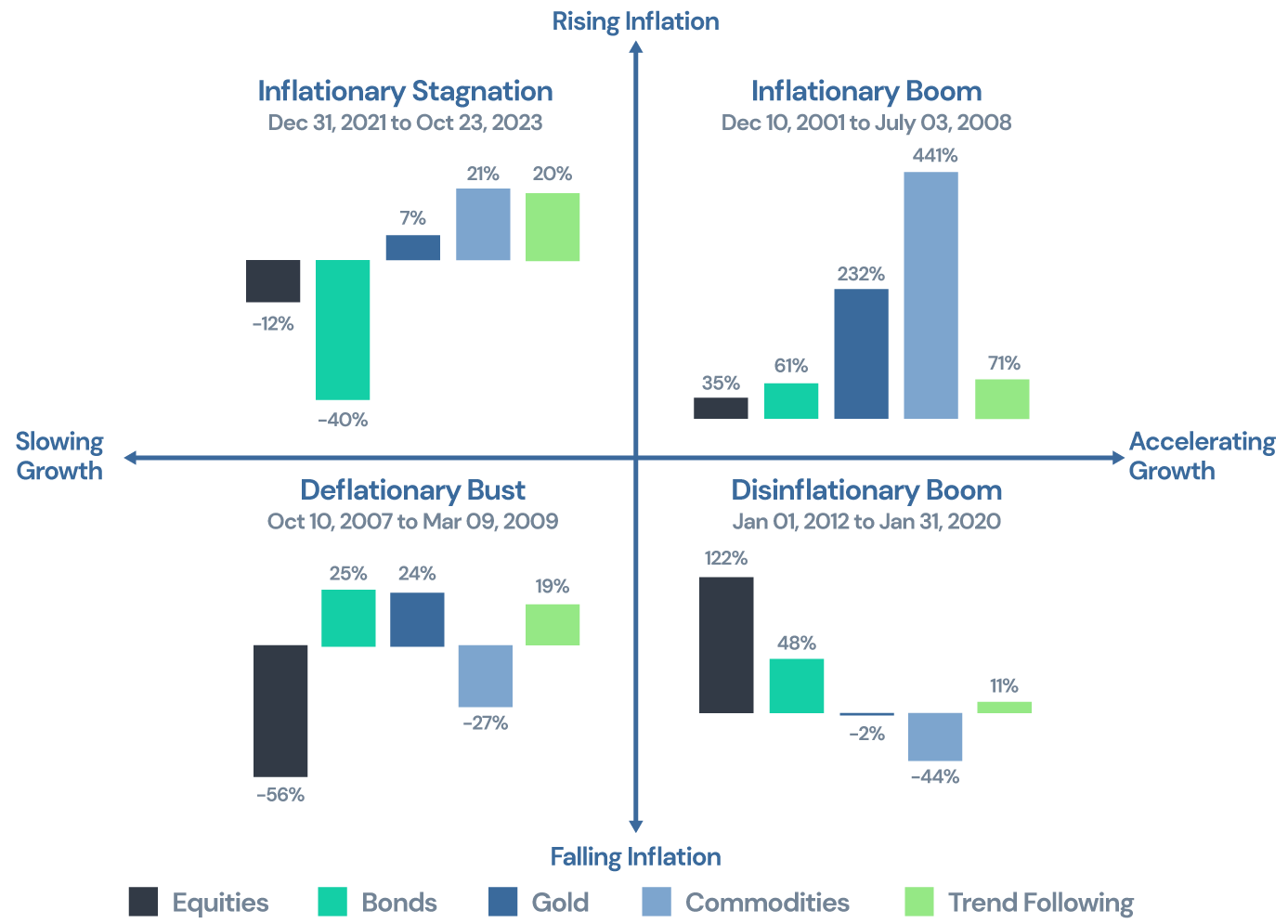
Source: Bloomberg and Société Générale. Analysis ReSolve Asset Management SEZC (Cayman). Equities is MSCI All Country World Index (“ACWI”), Bonds is ICE U.S. Treasury 20+ Year Bond Index Total Return (ICET20X2), Gold is Gold Index (“XAUUSD”), Commodities is DBIQ Optimum Yield Diversified Commodity Index (DBLCDBCT), Trend Following is the Société Générale Trend Index (“NEIXCTAT”). You cannot invest in an index. Returns are gross of taxes. Past performance is not indicative of future results.
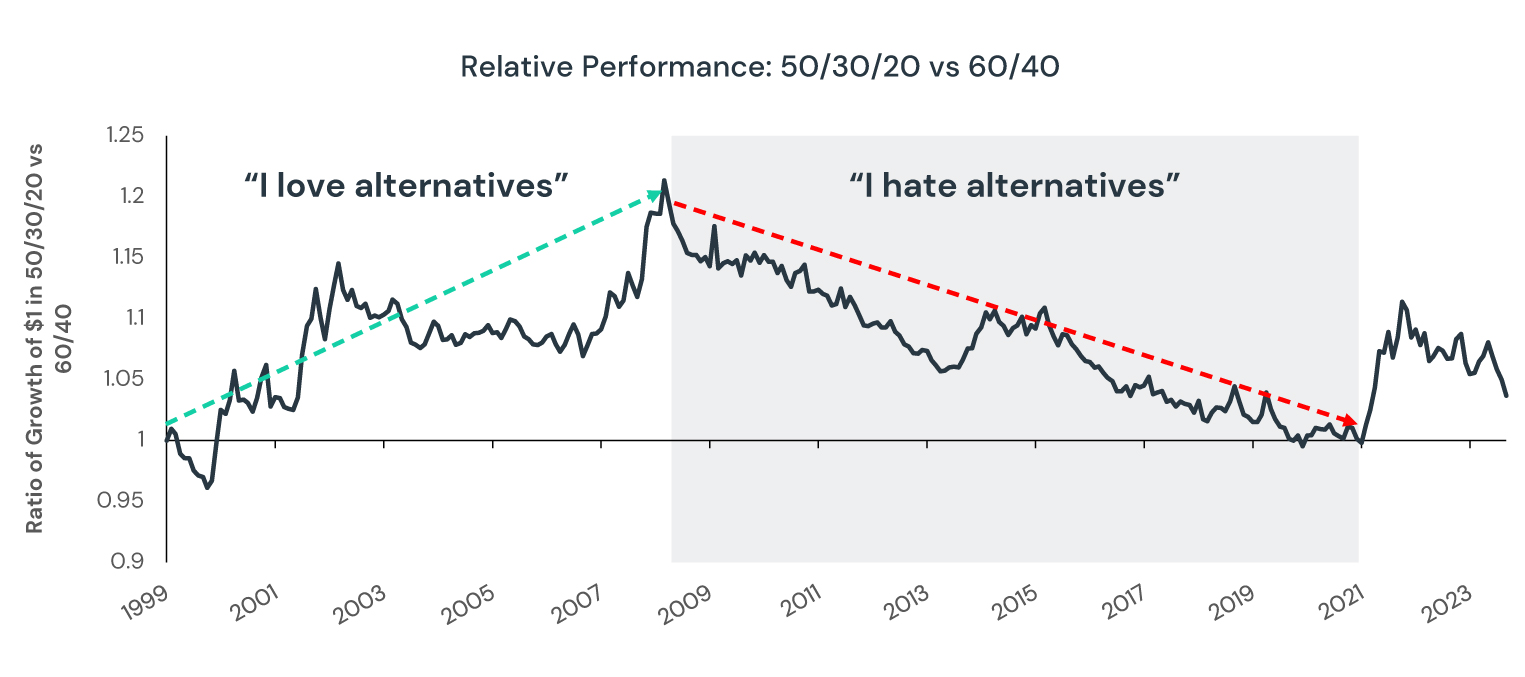
Relative-Performance-50-30-20-vs-60-40

The green line and “I love alternatives” Illustrates a period where a 20% allocation to alternatives is outperforming the rest of the portfolio which could make it easier for investors to hold relative to a 60/40 portfolio. The red line, grayed out area and “I hate alternatives” represent a period where a 20% allocation to alternatives are underperforming the rest of the portfolio and could make it harder to hold from behaviorally. Source: Bloomberg and Société Générale.  U.S. Stocks is the S&P 500 Index (“SPX”).  U.S. Bonds is the Bloomberg US Aggregate Bond Index (“LBUSTRUU”).  Returns for both U.S. Stocks and U.S. Bonds are gross of all fees. CTA Trend is the Société Générale Trend Index (“NEIXCTAT”), an index designed to track the largest trend following commodity trading advisors (“CTAs”) in the managed futures space net of underlying fees. 50/30/20 is 50% U.S. Stocks / 30% U.S. Bonds / 20% CTA Trend rebalanced monthly.  60/40 is 60% U.S. Stocks / 40% U.S. Bonds rebalanced monthly. You cannot invest in an index. Returns are gross of taxes.  Returns assume the reinvestment of all distributions.  Past performance is not indicative of future results. Period is 12/31/1999 through 8/31/2024. The starting date is chosen based upon the earliest date data is available for the underlying indexes.

"If diversification is so good, why don't all investors add alternatives to their portfolio?"

Ask enough investors and an answer becomes clear: it is not just a question about adding things to a portfolio, but also one of subtracting. 

To make room for an alternative investment strategy in their portfolio, you typically have to sell some of your core stocks and bonds. This can lead to a significant performance drag in periods where alternatives underperform these core assets.

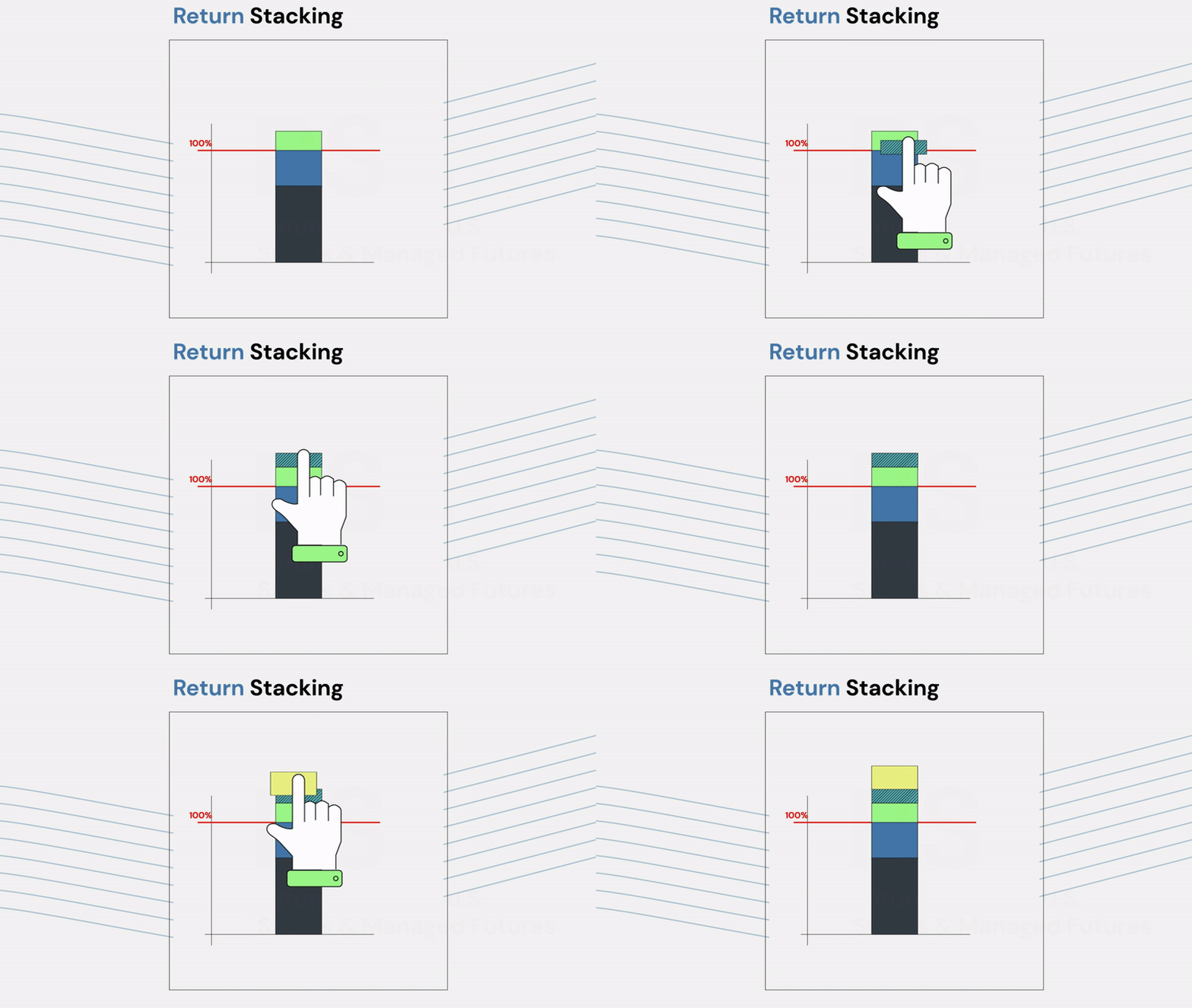
But what if you didn’t have to sell core stocks and bonds?  What if you could stack the alternative investment on top?

Introducing Return Stacking

At its core, return stacking is the idea of layering one investment return on top of another, achieving more than $1.00 of exposure for each $1.00 invested.

By wrapping this concept into professionally managed mutual funds and exchange-traded funds, we seek to provide investors with the building blocks to unlock the benefits of diversification in their own portfolios.
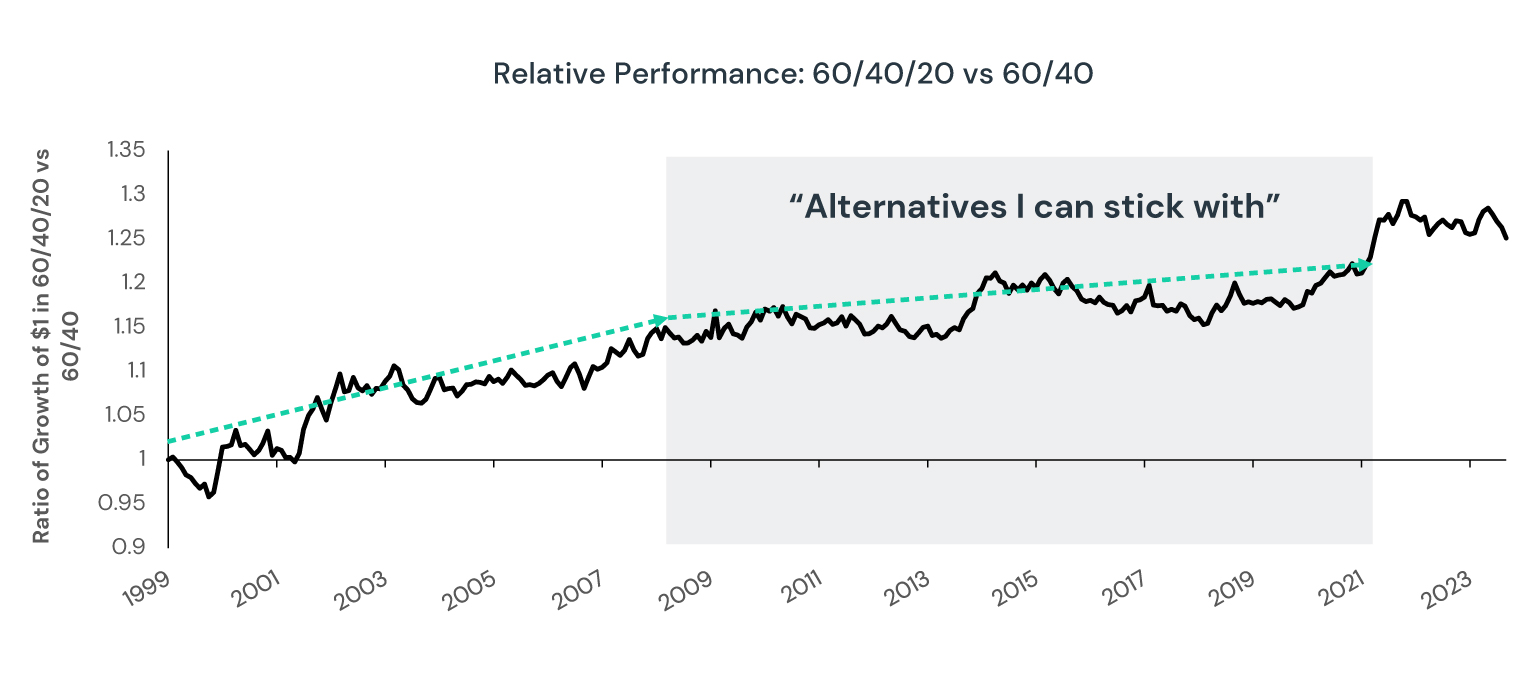
The green line and the phrase “Alternatives I can stick with” help illustrate how stacking 20% to alternatives on top of a 60/40 portfolio exhibited more consistent, upward sloping relative performance even in the decade where managed futures did poorly relative to a 60/40 portfolio (the gray area) and hence could make it easier to hold from a behavioral perspective. Source: Bloomberg and Société Générale.  U.S. Stocks is the S&P 500 Index (“SPX”).  U.S. Bonds is the Bloomberg US Aggregate Bond Index (“LBUSTRUU”). Returns for both U.S. Stocks and U.S. Bonds are gross of all fees.  CTA Trend is the Société Générale Trend Index (“NEIXCTAT”), an index designed to track the largest trend following commodity trading advisors (“CTAs”) in the managed futures space net of underlying fees. 60/40 is 60% S&P 500 Index and 40% Bloomberg U.S. Aggregate Bond Index rebalanced monthly. 60/40/20 is the 60/40 portfolio plus 20% in the Société Générale Trend Index minus 20% in the Bloomberg Short Treasury US Total Return Index (“LD12TRUUU”). You cannot invest in an index. Returns are gross of taxes.  Returns assume the reinvestment of all distributions.  Past performance is not indicative of future results.  Period is 12/31/1999 through 8/31/2024. The starting date is chosen based upon the earliest date data is available for the underlying indexes.

Making Diversification Sustainable

Selling stocks or bonds to make room for alternatives can lead to performance drag when those alternatives underperform.

Return stacking allows you to maintain your core portfolio assets and introduce a strategic allocation to alternatives for the inevitable periods when the core assets struggle.

Return Stacking in Action

Return stacking is the idea of layering diversifying investments on top of a traditional portfolio rather than replacing existing holdings. Use the slider below to explore how stacking Managed Futures on top of a 60/40 stock/bond portfolio would have historically affected performance.

Choose the Size of Your Stack
20%
Metric 60/40 Stacked Difference

For the Difference column, green text means improved outcomes and red text means worsened outcomes.

For the Difference row, green text means improved outcomes and red text means worsened outcomes.

Source: Bloomberg; PivotalPath. Bonds is the Bloomberg US Aggregate Bond Index (“LBUSTRUU”). Managed Futures is the PivotalPath Managed Futures Index (“MFT”). Stocks is the S&P 500 Total Return Index (“SPX”). T-Bills is the Bloomberg Short Treasury US Total Return Index (“LD12TRUUU”). The Stock/Bond portfolio is 60% Stocks / 40% Bonds rebalanced monthly. The Stacked portfolio is 60% Stocks / 40% Bonds plus a user-selected allocation to Managed Futures, financed at T-Bills + 50 bp. Assumed annual costs: Managed Futures: 0 bp fee (the PivotalPath Managed Futures Index is reported net of fees) / 50 bp financing. See methodology below for an explicit explanation of how portfolio returns are calculated. See glossary below for index definitions. You cannot invest in an index. Portfolio returns are hypothetical. Returns are gross of all fees, including management costs, transaction costs, and taxes, except where explicitly stated otherwise. Returns assume the reinvestment of all distributions. Period is 12/31/1999 through 12/31/2025. The starting date is chosen based upon the earliest date data is available for the underlying indexes. Past performance is not indicative of future results.

Important Disclosures on Hypothetical Performance

The portfolio returns set forth herein represent a series of differently weighted portfolios comprised of historical index returns; any such portfolio returns should be considered hypothetical and are for illustrative purposes. You are cautioned that hypothetical performance results have many inherent limitations, some of which are described herein.

Indexes are unmanaged and you cannot invest in an index. No representation is being made that any account will or is likely to achieve profits similar to those shown or will not be able to avoid substantial losses. In fact, frequently there are sharp differences between hypothetical performance results and actual performance an investor’s portfolio achieves.

The hypothetical portfolio in this presentation assumes full investment, whereas an actual investor’s portfolio would most likely have a positive cash position. Had the hypothetical portfolio included a cash position, the information would have been different and generally may have been lower.

An additional limitation of hypothetical performance results is that they are generally prepared with the benefit of hindsight.

Furthermore, the construction of a hypothetical portfolio of investments does not involve financial risk, and no hypothetical portfolio of investments can completely account for the impact of financial risk in actual trading. For example, the ability to withstand losses or to adhere to a particular trading program in spite of trading losses are material points which can also adversely affect actual trading results. There are numerous other factors related to the markets in general or the implementation of a portfolio of investments which cannot be fully accounted for in the preparation of hypothetical performance results, all of which can adversely affect actual trading results.

Methodology

The Stock/Bond portfolio allocates 60% to Stocks and 40% to Bonds. The portfolio is rebalanced monthly: each month’s return is computed as the weighted average of the individual asset returns, and the portfolio value is compounded forward.

The Stacked portfolio begins with the same 60/40 Stock/Bond base and layers on additional Managed Futures exposure. This alternative exposure is scaled by the user-specified stack size. The stacked exposure is financed by selling an equivalent notional amount of T-Bills short. The Managed Futures contribution is reduced by two costs: (1) a Fee, representing the cost of accessing the strategy, and (2) a Financing Cost, representing the spread above T-Bills required to carry the leveraged position. In formula terms, the monthly Stacked return is:

RStacked = R60/40 + Stack Size × (RManaged Futures − Fee/12 − (RT-Bills + Financing/12))

At a Stack Size of 100%, the portfolio holds $1 of the 60/40 allocation plus $1 of notional Managed Futures exposure—resulting in $2 of total notional exposure on $1 of capital. The cost of financing the leveraged exposure is modeled as T-Bills plus a 50 bp annual financing spread. At 0%, the Stacked portfolio is identical to the Stock/Bond portfolio.

The Managed Futures fee is set to zero because the PivotalPath Managed Futures Index is reported net of fees. The financing cost is assumed to be 50 bp annually, representing the estimated spread above T-Bills required to carry the leveraged position. All portfolios assume monthly rebalancing back to target weights with no transaction costs.

Index Definitions

Bloomberg Short Treasury US Total Return Index tracks the market for treasury bills issued by the US government with time to maturity between 1 and 3 months.

Bloomberg US Aggregate Bond Index is an index that covers the broad U.S. investment grade, US dollar-denominated, fixed-rate taxable bond market.

PivotalPath Managed Futures Index is an equal weighted index of funds that typically forecast market trends and determine whether to invest long or short in futures contracts across metals, grains, equity indices and soft commodities, as well as foreign currency and U.S. government bond futures. The Index tracks the monthly performance, net of fees in USD, of its constituents and is representative of funds with a minimum fund track record of 18 months and a minimum fund AUM of $50mm. The constituents are fixed at the end of each calendar year for the following calendar year.

S&P 500 Index is an abbreviation for the Standard & Poor’s 500, a market-capitalization-weighted index of 500 leading publicly traded companies in the U.S.

Term Definitions

Annualized Return is the geometric average return per year over a specified period, reflecting the compounding of returns.

Basis Point (bps) is a unit of measure equal to one one-hundredth of one percent (0.01%). It is commonly used to express changes in interest rates, fees, and investment returns.

Drawdown is the peak-to-trough decline in the value of a portfolio or investment, expressed as a percentage from the peak. It measures the largest loss an investor would have experienced if they bought at the highest point and sold at the lowest point before a new peak was reached.

Financing Cost is the cost of borrowing or carrying a leveraged position, expressed as a spread above the T-Bill rate.

Hypothetical/Backtested Performance refers to performance results generated by retroactively applying an investment strategy to historical data. Backtested results are not actual trading results and have inherent limitations, including the benefit of hindsight.

Log Scale uses a logarithmic axis so that equal vertical distances represent equal percentage changes. This makes it easier to compare growth rates across different time periods, especially over long horizons where compounding can make early returns appear flat on a linear scale.

Leverage is the use of borrowed capital or financial instruments to increase the potential return (and risk) of an investment. In the context of this tool, stacking creates leveraged exposure by financing alternative positions through a short T-Bill position.

Managed Futures refers to an alternative investment consisting of a portfolio of futures contracts that is actively managed by professionals.

Rebalancing is the process of periodically adjusting portfolio weights back to target allocations, which may involve buying or selling assets.

T-Bills (Treasury Bills) are short-term U.S. government debt securities with maturities of one year or less, generally considered among the lowest-risk investments.

Volatility is a statistical measure of the dispersion of returns for a given security or market index, commonly calculated as the standard deviation of returns. Higher volatility indicates greater price fluctuation and, therefore, greater risk.

PivotalPath Disclosure

The PivotalPath index/indices used in this information is/are produced by the hedge fund research and investment consultancy firm, PivotalPath Inc. The information is representative of the overall composition of the hedge fund universe, as well as specific sub-strategies, including but not limited to the PivotalPath Hedge Fund Composite Index; the PivotalPath Credit Index (and associated sub-indices); the PivotalPath Equity Diversified Index (and associated sub-indices); the PivotalPath Equity Sector Index (and associated sub-indices); the PivotalPath Event Driven Index (and associated sub-indices); the PivotalPath Global Macro Index (and associated sub-indices); the PivotalPath Managed Futures Index; the PivotalPath Multi-Strategy Index; PivotalPath Equity Quant Index; and the PivotalPath Volatility Index.

PivotalPath Indices are the proprietary product of PivotalPath Inc. They represent Hedge Fund Indices based on collected data from individual hedge funds and while PivotalPath considers the sources of such information and data to be reliable, such information and data has been verified but has not been audited by PivotalPath. No representation is made as to, and no responsibility or liability is accepted for, the accuracy or completeness of such information and data. PivotalPath Index constituents may be removed at any time and any PivotalPath index may be restated, adjusted, or corrected at any time without notice.

PivotalPath data is being used under license from PivotalPath, Inc, which does not approve of or endorse any of the products or the contents discussed in these materials.

Important Information

The information set forth in this document has been obtained or derived from sources believed by Newfound Research LLC and ReSolve Asset Management SEZC (jointly “Return Stacked® Portfolio Solutions”) to be reliable. However, Return Stacked® Portfolio Solutions does not make any representation or warranty, express or implied, as to the information’s accuracy or completeness, nor does Return Stacked® Portfolio Solutions recommend that the information serve as the basis of any investment decision.

Certain information contained in this document constitutes “forward-looking statements,” which can be identified by the use of forward-looking terminology such as “may,” “will,” “should,” “expect,” “anticipate,” “project,” “estimate,” “intend,” “continue,” or “believe,” or the negatives thereof or other variations or comparable terminology. Due to various risks and uncertainties, actual events or results or the actual performance of an investment managed using any of the investment strategies or styles described in this document may differ materially from those reflected in such forward-looking statements. The information in this document is made available on an “as is,” without representation or warranty basis.

There can be no assurance that any investment strategy or style will achieve any level of performance, and investment results may vary substantially from year to year or even from month to month. An investor could lose all or substantially all of his or her investment. Both the use of a single adviser and the focus on a single investment strategy could result in the lack of diversification and consequently, higher risk. The information herein is not intended to provide, and should not be relied upon for, accounting, legal or tax advice or investment recommendations. Any investment strategy and themes discussed herein may be unsuitable for investors depending on their specific investment objectives and financial situation. You should consult your investment adviser, tax, legal, accounting or other advisors about the matters discussed herein. These materials represent an assessment of the market environment at specific points in time and are intended neither to be a guarantee of future events nor as a primary basis for investment decisions. Past performance is not indicative of future performance and investments in equity securities do present risk of loss.

Investors should understand that while performance results may show a general rising trend at times, there is no assurance that any such trends will continue. If such trends are broken, then investors may experience real losses. The information included in this presentation reflects the different assumptions, views and analytical methods of Return Stacked® Portfolio Solutions as of the date of this document. The views expressed reflect the current views as of the date hereof and neither the author nor Return Stacked® Portfolio Solutions undertakes to advise you of any changes in the views expressed herein.

This presentation has been provided solely for informational purposes and does not constitute a current or past recommendation or an offer or solicitation of an offer, or any advice or recommendation, to purchase any securities or other financial instruments, and may not be construed as such. This presentation should not be considered as investment advice or a recommendation of any particular security, strategy or investment product.

No part of this document may be reproduced in any form, or referred to in any other publication, without express written permission from Return Stacked® Portfolio Solutions.

© Return Stacked® Portfolio Solutions, 2026. All rights reserved.

Want to build your own custom stack?

Read the original Return Stacking whitepaper here.

An Old Idea Reborn

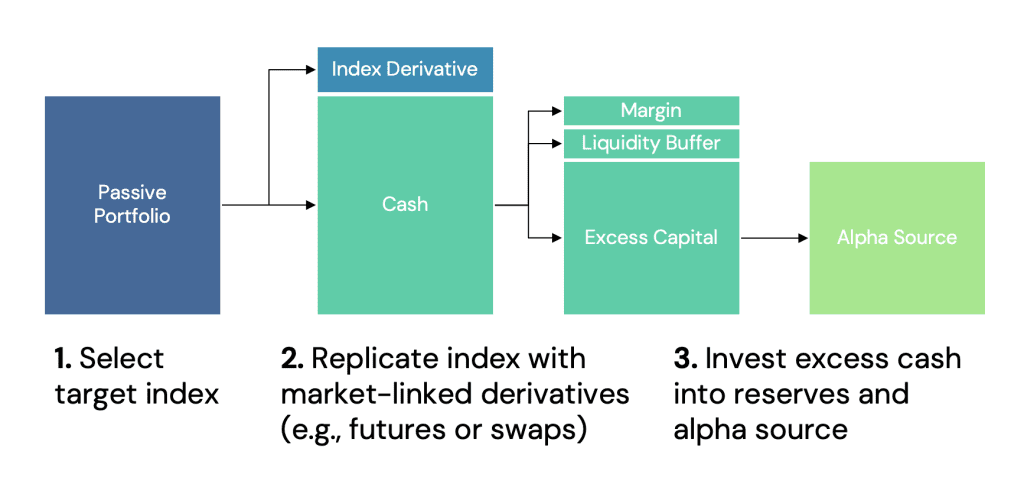
In the 1980s, the Pacific Investment Management Company (PIMCO) launched their StocksPLUS series of strategies.  The idea was simple, but powerful.  Rather than search for alpha in large-cap equities, where competition was fierce, they would buy passive equity exposure and look for alpha in short-term, high quality bonds.

To make this idea work, PIMCO would gain its equity exposure through capital efficient derivatives such as futures and swaps.  This meant they only had to outlay a fraction of their capital to achieve the passive equity exposure, leaving the remainder of the capital available for investing in bonds!

Mechanics of a portable alpha implementation
For illustrative purposes only.

Over time, investors realized that this design allowed investors to separate beta from alpha.  By implementing beta through capital efficient derivatives, valuable capital can be unlocked and reinvested in potentially diversifying alternative return streams.

This concept became known as portable alpha.

Portable Alpha for Everyone

For decades, sophisticated institutional investors have used portable alpha to include diversifying alternative strategies without diluting their core stock and bond allocations. Due to the complexity of managing derivatives, small institutions, financial advisors, and individuals have largely been locked out of this approach.

Today, professionally managed mutual fund and exchange-traded products allow investors to implement this concept.

At Return Stacked® Portfolio Solutions, we are developing the research, product design, and portfolio construction that unlocks this opportunity for everyone.

Explicitly Stacking Alternatives

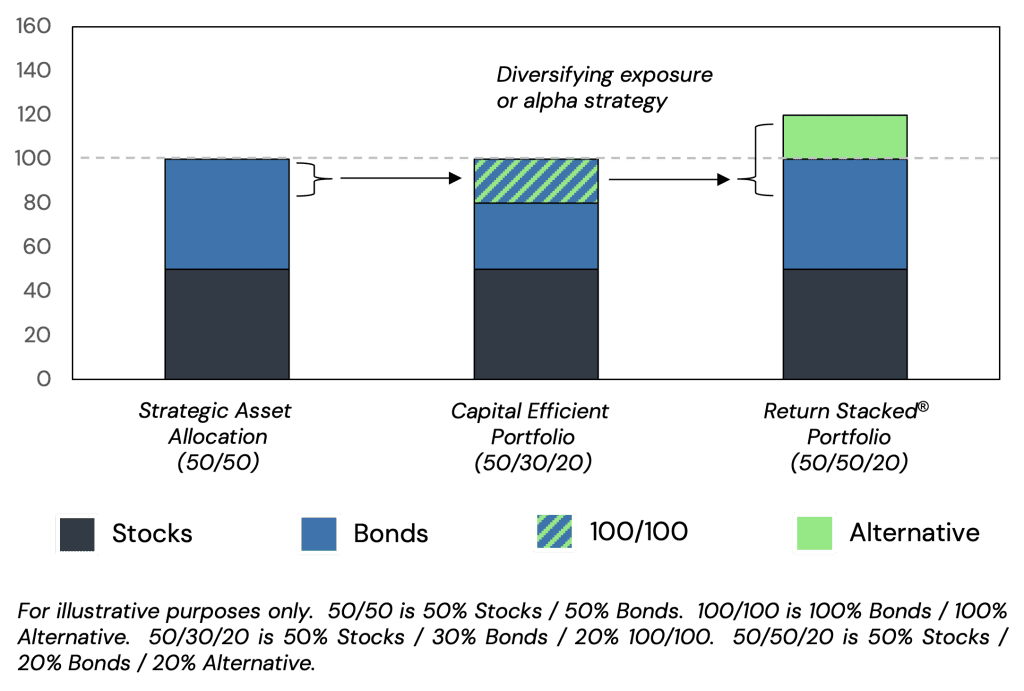
Funds implementing return stacking may combine a variety of betas (e.g., stocks and bonds), non-traditional betas (e.g., commodities), and alternative investment strategies in a variety of leverage targets to provide capital efficient exposure for investors.

As an example, consider a fund that seeks to provide $1 of exposure to bonds and $1 of exposure to alternatives for every $1 invested.  If you wanted to stack the alternative strategy on top of your existing portfolio, you could simply sell some of your bonds and buy the fund.

Packaging portable alpha into a fund structure can allow investors to explicitly stack alternatives on their portfolio
Making Room in a Portfolio

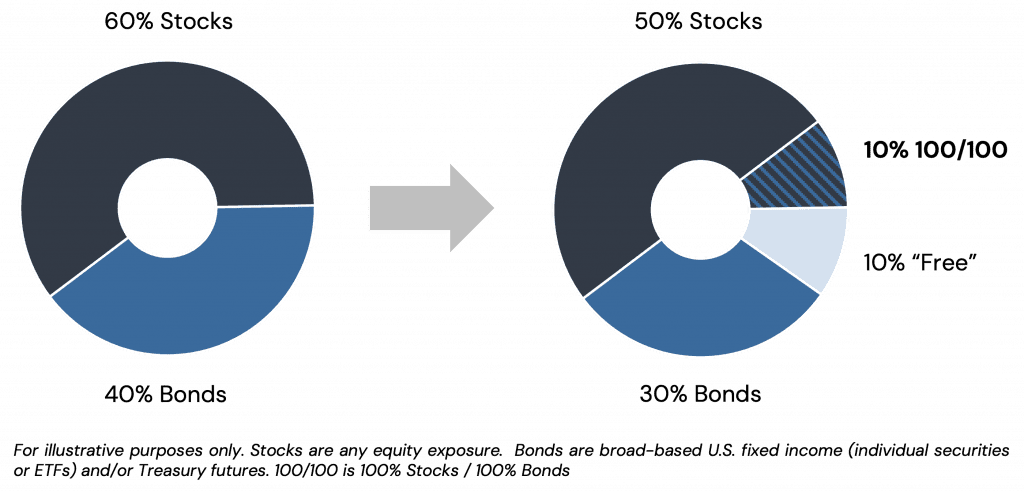
Assume you held a 60% stock / 40% bond portfolio.  You could replace some of your holdings with a fund that provides 2x exposure to a 50% stock / 50% bond portfolio (a “100/100” fund).  For example, by selling 10% of your stocks and 10% of your bonds and allocating 10% to such a fund, you create a capital efficient implementation that frees up 10% of the portfolio for a variety of potential uses.

For example, it might also be allocated to alternative assets and strategies that have the potential to introduce beneficial diversification to the portfolio.  You could also leave it in Treasury Bills (or a money market fund) to help better manage cash-flow needs (e.g. withdrawals or capital calls) without sacrificing core stock and bond exposure.

Packaging portable alpha into a fund structure can allow investors to free up room in their portfolio
Why Return Stacking?

For decades, sophisticated institutional investors have thoughtfully applied leverage to include diversifying alternative strategies without diluting their core stock and bond allocations. Due to the complexity of managing derivatives, small institutions, financial advisors, and individuals have largely been locked out of this approach.

Today, professionally managed mutual fund and exchange-traded products allow investors to implement this concept.  We are developing the research, product design, and portfolio construction that unlocks this opportunity for everyone.

Pursuing Diversification without Sacrifice

Investors can introduce diversifying assets and strategies without sacrificing exposure to their traditional asset allocation.

Opportunity for
Enhanced Returns

By introducing additional sources of return, Return Stacking creates the potential for outperformance, which may be particularly attractive in an environment where expected returns for traditional assets may be muted.

Potential to
Improve Diversification

By thoughtfully introducing differentiated return streams, investors may gain a diversification advantage with the potential to reduce portfolio volatility and drawdowns.

Managing Investor (Mis-)Behavior

Alternative investments can be difficult to stick with, particularly when they underperform traditional assets for years on end (often with higher costs, less tax efficiency, and less transparency).

Historically, to make room for alternatives in your portfolio, you would have to sell core stock and bond exposure.  The choice to add alternatives is also a choice to subtract stocks and bonds.  This has the potential of creating meaningful underperformance during strong bull markets.

With return stacking, you have the potential to maintain your core stock and bond exposure, reducing tracking error to your benchmark.

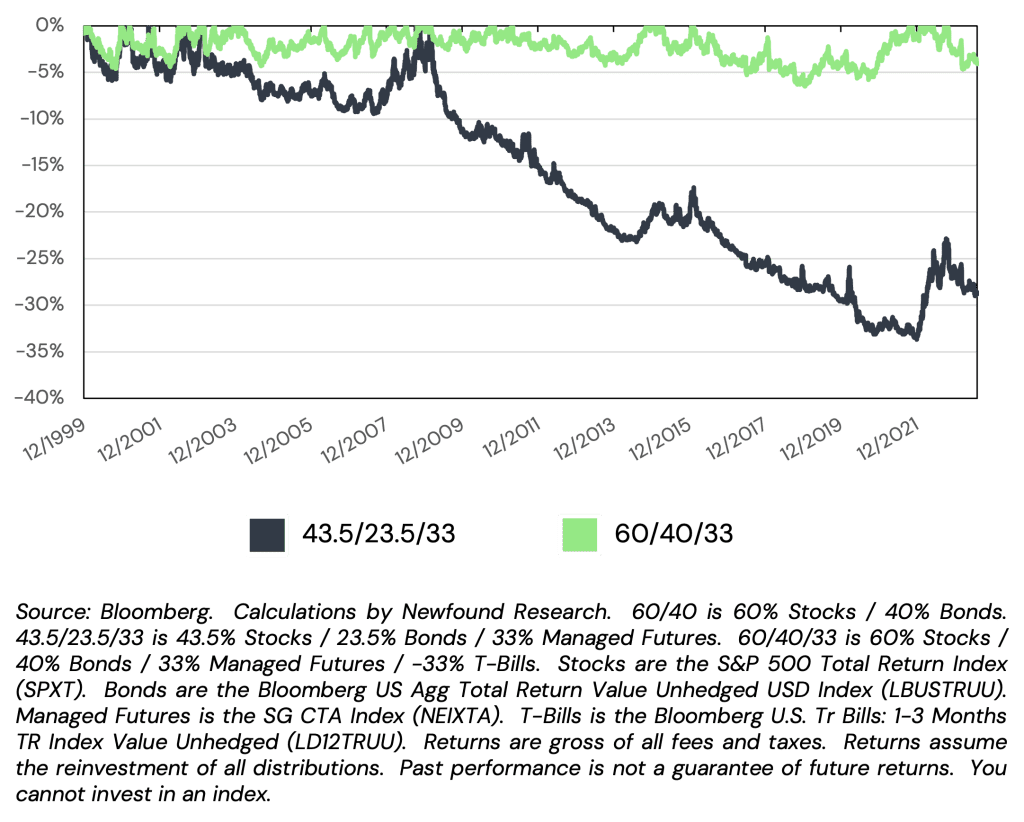
In the figure below, we assume an investor has a 60% S&P 500 / 40% Bloomberg Core US Bond benchmark.  In the first case, they allocate 33% of their portfolio to managed futures by selling stocks and bonds equally.  In the second case, they stack the returns on top.  The figure plots the relative drawdown of these portfolios versus the benchmark, showing the periods when they would have underperformed, how much they would have underperformed by, and for how long.

Relative drawdowns versus a 60/40 of two different methods of including alternatives in a portfolio

GETTING STARTED

New to Return Stacking?

If you’re new to the idea of Return Stacking, you’re in the right place. The best way to learn about the philosophy, start to understand how you can optimize your clients’ portfolios, and stay up to date with the latest research is to subscribe to our newsletter.