
Return Stacking and Fund Distributions: How Structure Drives Tax Drag
Overview
This article explores how a Return Stacked® strategy combining U.S. equities and Treasuries can be implemented in multiple ways, and how those structural choices influence fund distributions and potential tax drag for investors.
Key Topics
Return Stacking, Capital Efficiency, Tax Efficiency
Introduction
For many investors, the difference between what a portfolio earns and what they keep comes down to taxes, making tax efficiency just as critical as fees when evaluating strategy design. That is why tax efficiency is one of the most common questions we receive about Return Stacked® solutions – and is a core consideration in our portfolio design.
In a previous post, we sought to address how taxes can affect expected returns. In this brief article, we walk through portfolio construction choices for a hypothetical Return Stacked® strategy designed to provide 100% U.S. large-cap equity exposure and 100% broad U.S. Treasury exposure. We then connect those choices to fund distribution mechanics and potential tax drag for shareholders.
Three ways to build the same (gross) exposures
For a 100% U.S. Equity / 100% U.S. Treasury strategy, there are three straightforward implementations:
- All Futures Implementation (“Option 1”): Keep 100% of assets as margin collateral and obtain exposure via S&P 500 futures plus a ladder of U.S. Treasury futures.
- Cash Equities + Treasury Futures (“Option 2”): Hold 90% in S&P 500 equities (or an S&P 500 Index ETF) and hold 10% cash to collateralize S&P 500 E-Mini and Treasury Bond futures.
- Cash Bonds + Equity Futures (“Option 3”): Hold 90% in broad U.S. Treasuries (or a U.S. Treasury bond index ETF) and use 10% cash to collateralize Treasury and S&P 500 E-Mini futures.
Each of these approaches is designed to reach the same destination: a portfolio that combines 100% equity exposure with 100% Treasury exposure. The use of futures in this context should not be seen as simply levering an asset class in isolation, but rather as a tool to efficiently deliver the total 100/100 strategy.
On a gross, pre-tax basis, these three options are largely similar; differences primarily reflect the embedded financing costs in the futures.
Figure 1. Strategy Construction Options
|
|
Option 1 |
Option 2 |
Option 3 |
|
Margin Cash |
100% |
10% |
10% |
|
Cash Equities |
0% |
90% |
0% |
|
Cash Bonds |
0% |
0% |
90% |
|
S&P 500 Futures |
100% |
10% |
100% |
|
US Treasury Bond Futures |
100% |
100% |
10% |
Sources: Newfound Research. For illustrative purposes only.
Figure 2: Gross Index Returns of 100% U.S. Equity / 100% U.S. Treasury Strategies
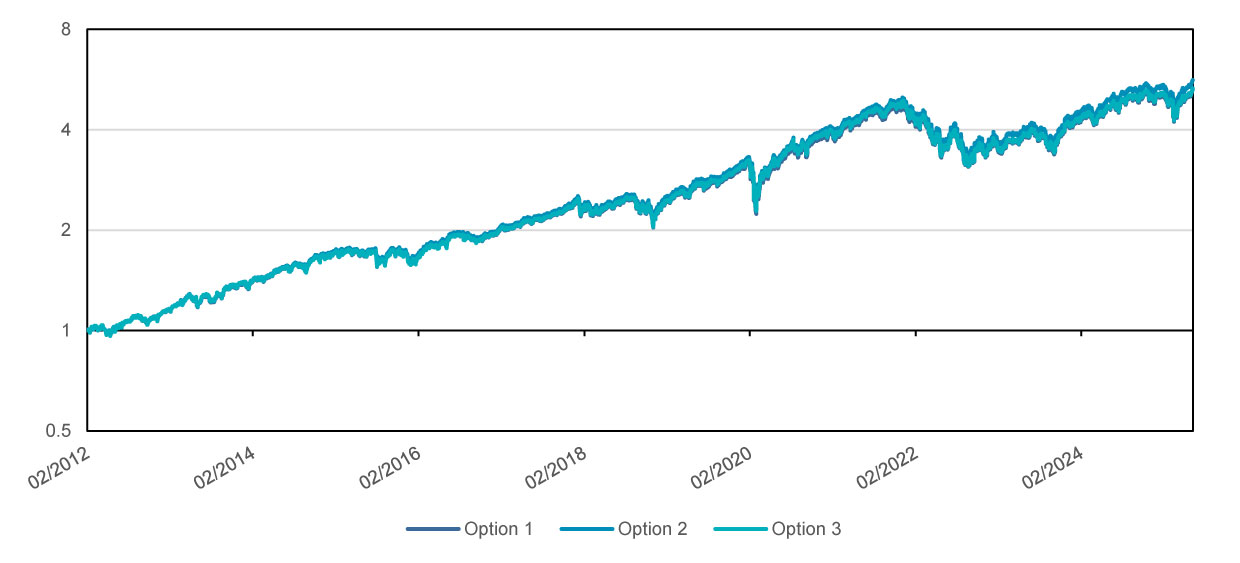
Sources: Tiingo, CSI. Calculations by Newfound Research. Illustrative only. Margin cash is the SPDR Bloomberg 1-3 Month T-Bill ETF (ticker: BIL); Cash equities is the SPDR S&P 500 ETF Trust (ticker: SPY); Cash bonds is the iShares US Treasury Bond ETF (ticker: GOVT); S&P 500 Futures is a continuous E-Mini S&P 500 Futures Contract (ES); US Treasury Bond Futures is an equal-weight portfolio of 2-Year T-Note Futures (TU), 5-Year T-Note Futures (FV), 10-Year T-Note Futures (TY), and U.S Treasury Bond Futures (US). Portfolio is rebalanced daily. Returns are gross of all fees, transaction costs, and taxes, except for the any management fees of underlying holdings. Returns assume the reinvestment of all distributions.
Register for our Advisor Center
Tools Center:
Easily backtest & explore different return stacking concepts
Model Portfolios:
Return stacked allocations, commentary and guidance designed
for a range of client risk profiles and goals
Future Thinking:
Receive up-to-date insights into the world of return stacking theory and practice

Taxes Break the Tie
While gross returns are similar, after-tax results are not. That is because the source and frequency of returns and taxable income differ across cash securities and futures. In general:
- Cash equities: Realize gains/losses when sold; dividends tend to be a minority of total return but are taxed as either qualified income or ordinary income.
- Cash bonds: Coupons (often the bulk of return) are taxed as ordinary income.
- Equity Index and Treasury futures: Section 1256 contracts are marked-to-market daily, with gains/losses taxed 60% long-term / 40% short-term (the “60/40” rule).
The implication of this comparison is that not all structures are created equal. While each approach delivers the same gross exposures, the way those exposures are implemented can drive very different tax outcomes. In particular, combining cash equities with Treasury futures tends to be more favorable from a tax perspective than holding cash bonds with equity futures, since the former preserves the potential tax efficiency of equities while avoiding the coupon income drag of bonds.
Hypothetical Backtest of Distribution Outcomes
With that context in mind, we can attempt to assess how the fund’s distributions might have unfolded under a specific set of assumptions, parameters, and history. To illustrate, we constructed a backtest of the three implementation approaches, tracking transaction costs, fees, tax lots, and interest on collateral cash to estimate calendar-year distributions. This exercise highlights how the mechanics of structure can translate into different distribution profiles over time.
Figure 3: Hypothetical 100% Cash + S&P 500 E-Mini & U.S. Treasury Futures Distributions as % of Year-End NAV
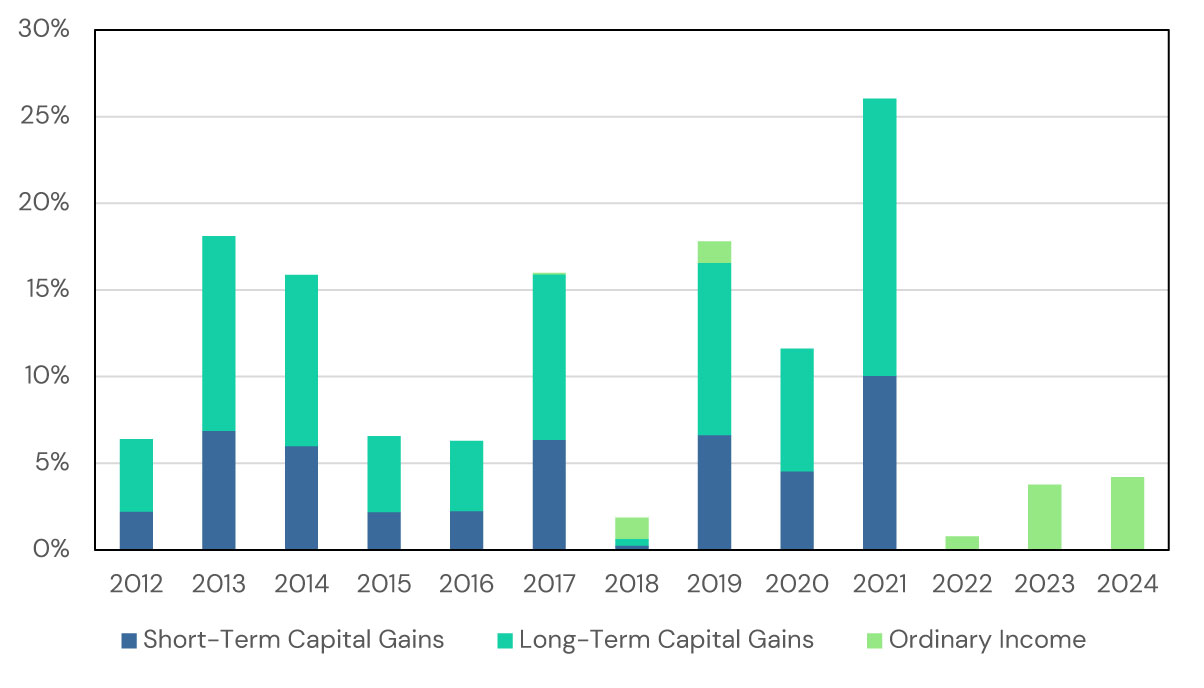
Sources: Tiingo, CSI. Calculations by Newfound Research. Illustrative only. Margin cash is the SPDR Bloomberg 1-3 Month T-Bill ETF (ticker: BIL); Cash equities is the SPDR S&P 500 ETF Trust (ticker: SPY); Cash bonds is the iShares US Treasury Bond ETF (ticker: GOVT); S&P 500 Futures is a continuous E-Mini S&P 500 Futures Contract (ES); US Treasury Bond Futures is an equal-weight portfolio of 2-Year T-Note Futures (TU), 5-Year T-Note Futures (FV), 10-Year T-Note Futures (TY), and U.S Treasury Bond Futures (US). Portfolio is rebalanced daily. Please see Appendix A for the full list of assumptions used in this analysis.
Figure 4: Hypothetical Cash Equities + Treasury Futures Distributions as % of Year-End NAV
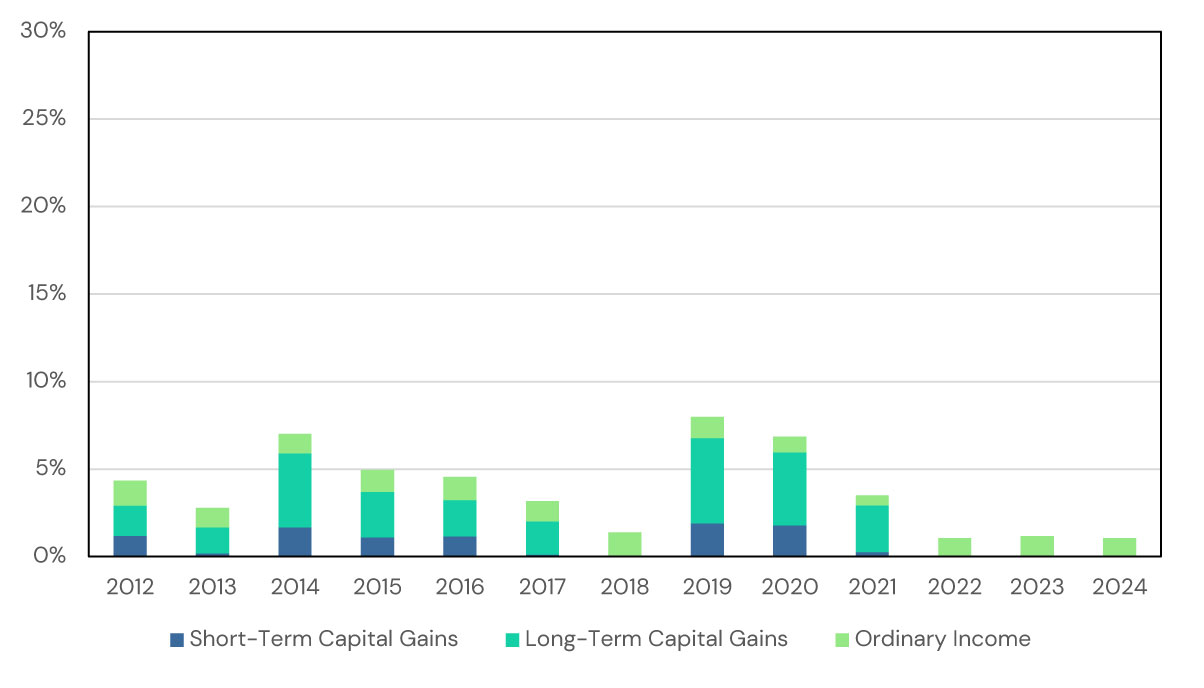
Sources: Tiingo, CSI. Calculations by Newfound Research. Illustrative only. Margin cash is the SPDR Bloomberg 1-3 Month T-Bill ETF (ticker: BIL); Cash equities is the SPDR S&P 500 ETF Trust (ticker: SPY); Cash bonds is the iShares US Treasury Bond ETF (ticker: GOVT); S&P 500 Futures is a continuous E-Mini S&P 500 Futures Contract (ES); US Treasury Bond Futures is an equal-weight portfolio of 2-Year T-Note Futures (TU), 5-Year T-Note Futures (FV), 10-Year T-Note Futures (TY), and U.S Treasury Bond Futures (US). Portfolio is rebalanced daily. Please see Appendix A for the full list of assumptions used in this analysis.
Figure 5: Cash Treasuries + S&P 500 E-Mini Futures Distributions as % of Year-End NAV
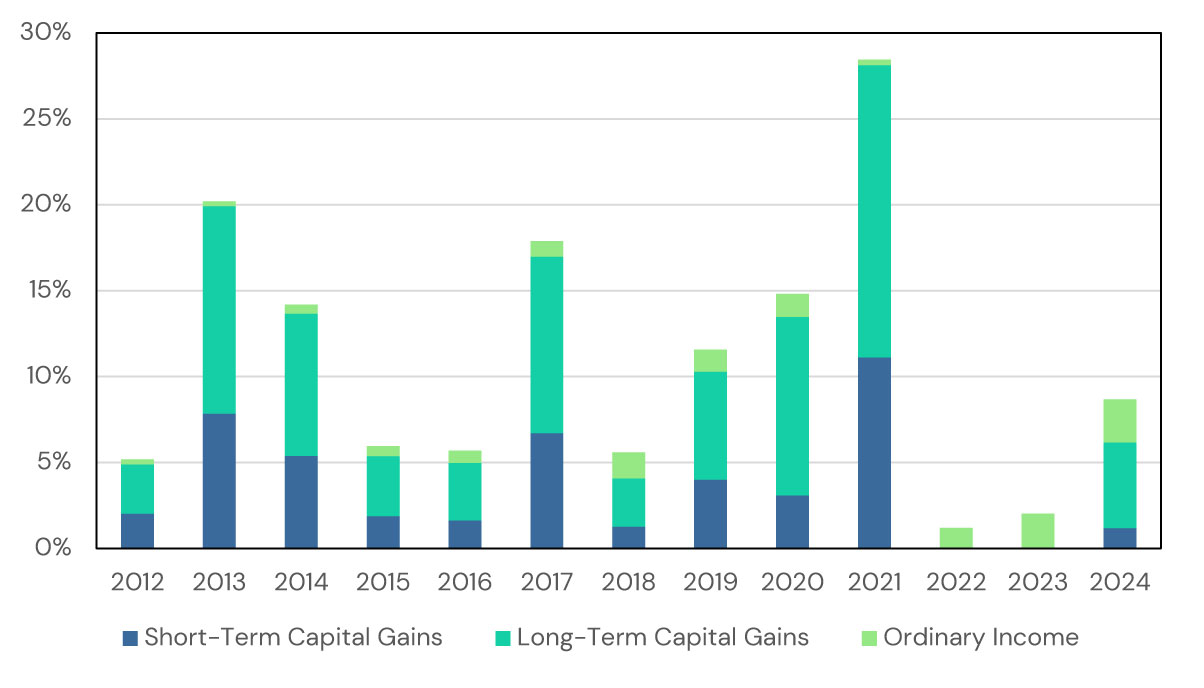
Sources: Tiingo, CSI. Calculations by Newfound Research. Illustrative only. Margin cash is the SPDR Bloomberg 1-3 Month T-Bill ETF (ticker: BIL); Cash equities is the SPDR S&P 500 ETF Trust (ticker: SPY); Cash bonds is the iShares US Treasury Bond ETF (ticker: GOVT); S&P 500 Futures is a continuous E-Mini S&P 500 Futures Contract (ES); US Treasury Bond Futures is an equal-weight portfolio of 2-Year T-Note Futures (TU), 5-Year T-Note Futures (FV), 10-Year T-Note Futures (TY), and U.S Treasury Bond Futures (US). Portfolio is rebalanced daily. Please see Appendix A for the full list of assumptions used in this analysis.
From Distributions to Estimated Tax Drag
Distributions increase taxable income but are not the tax bill itself. Actual tax owed depends on the type of distribution and each investor’s individual circumstances. For illustration – and consistent with SEC guidance for hypotheticals – we apply the maximum marginal federal rate and no state tax: ordinary income and short-term gains at 37% and long-term gains and qualified dividends at 20% 1.
We also need an assumption for qualified dividends. Using historical qualified-dividend percentages for a large S&P 500 ETF as a guide, we conservatively assume 95% qualified / 5% non-qualified 2.
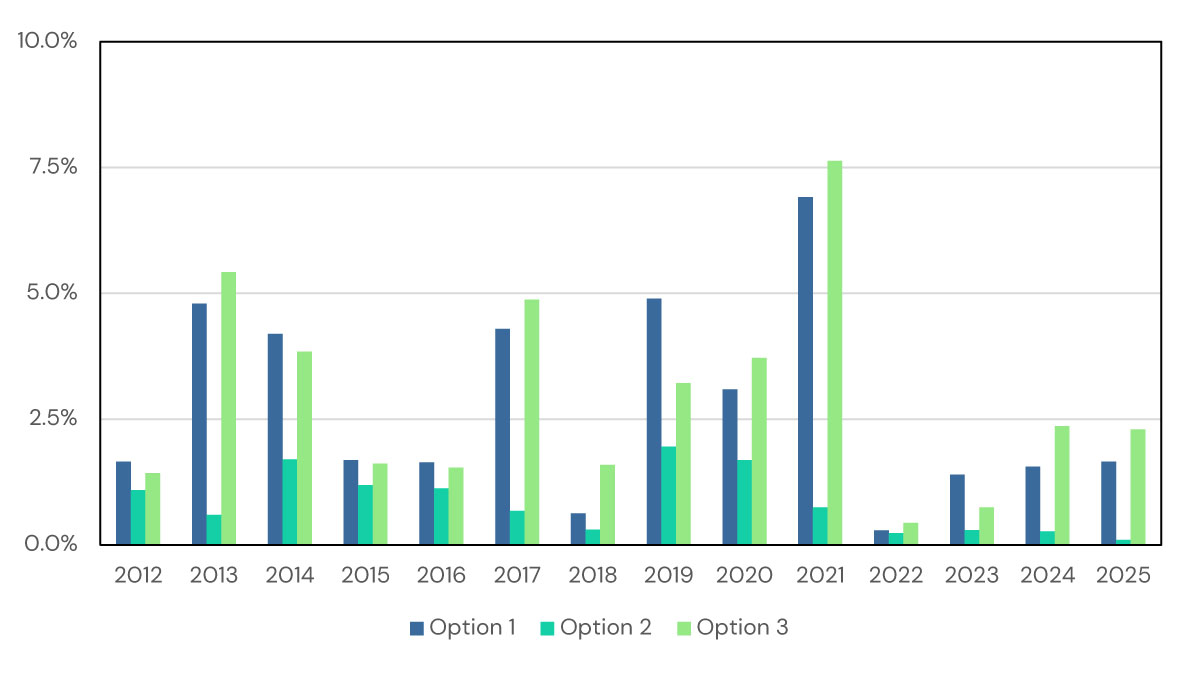
In Figure 6, we use these assumptions to estimate actual year-end tax liabilities as a percentage of investment value. For example, in 2024, the all-futures implementation (“Option 1”) had an estimated tax drag of 1.55% while Cash Equities + Treasury Futures (“Option 2”) had an estimated tax drag of just 0.27%.
Figure 6: Estimated Calendar-Year Federal Tax Liability as % of Year-End NAV
Sources: Tiingo, CSI. Calculations by Newfound Research. Illustrative only. Margin cash is the SPDR Bloomberg 1-3 Month T-Bill ETF (ticker: BIL); Cash equities is the SPDR S&P 500 ETF Trust (ticker: SPY); Cash bonds is the iShares US Treasury Bond ETF (ticker: GOVT); S&P 500 Futures is a continuous E-Mini S&P 500 Futures Contract (ES); US Treasury Bond Futures is an equal-weight portfolio of 2-Year T-Note Futures (TU), 5-Year T-Note Futures (FV), 10-Year T-Note Futures (TY), and U.S Treasury Bond Futures (US). Portfolio is rebalanced daily. Please see Appendix A for the full list of assumptions used in this analysis.
Taken together, the analysis suggests that some degree of tax drag is unavoidable, regardless of implementation. However, among the three structures, the approach that pairs cash equities with Treasury futures has historically produced the lowest modeled tax drag under the assumptions we applied.
Conclusion: Don’t Blindfold Your Diversifiers
This exercise highlights that substantially similar strategies with the same economic exposures can look very different once distributions and taxes are taken into account. While futures, cash equities, and cash bonds can each be used to deliver a stacked equity-and-Treasury profile, the tax treatment of those instruments leads to materially different investor experiences. In particular, structures that rely heavily on bond coupons or equity futures may generate larger taxable distributions, while approaches that combine cash equities with Treasury futures have historically tended to reduce the tax burden under the assumptions modeled here.
It is also important to remember that the use of Treasury futures in this context is not about levering Treasuries in isolation. Rather, they serve as a capital-efficient means of completing the full 100% equity / 100% Treasury allocation. The goal is the total portfolio exposure, not a stand-alone bet on Treasuries.
For investors, the lesson is straightforward but important: portfolio construction choices are not only about return streams and risk profiles, but also about the downstream tax consequences. Being thoughtful about implementation details can help investors preserve more of their gross return after taxes, even when the exposures on paper appear identical.
Key Takeaways
- The structure of a strategy matters: while different implementations can deliver the same gross exposures, the way those exposures are built can lead to very different tax outcomes.
- Using cash equities in combination with Treasury futures has historically resulted in lower modeled tax drag compared to alternative construction methods, making it a more tax-efficient way to achieve the desired exposures under our assumptions.
- Distributions are inherently path-dependent, meaning that market environments, the timing of losses, and the pattern of fund flows can all materially influence year-to-year outcomes.
- Actual tax liabilities will vary by client, so while fund-level modeling helps set expectations, advisors should always tailor their guidance to each investor's individual circumstances.
- Tax efficiency is ultimately a portfolio design decision, and choosing structures that account for tax treatment can improve after-tax results without changing the underlying exposures.
Appendix A: Tax and Accounting Assumptions
Federal tax rates. The analysis assumes a federal tax rate of 37% for non-qualified dividend income and short-term capital gains, and 20% for long-term capital gains and qualified dividends. No state tax is modeled, and the net investment income tax (NIIT) is excluded for simplicity.
Qualified dividends. For S&P 500 dividends, we assume a conservative mix of 95% qualified and 5% non-qualified.
Modeling framework. All results are illustrative, based on historical data sources listed in the figure captions. Outcomes are inherently path-dependent, and we assume the hypothetical fund has no inflows or outflows.
RIC treatment. To maintain regulated investment company (RIC) status, funds generally distribute substantially all net investment income and realized capital gains annually. Capital loss carryforwards, which may be used indefinitely under current rules, can offset future gains and are a key driver of path-dependence. The analysis assumes that 100% of any distributable income or capital gains is paid at year-end.
Section 1256 passthrough. Gains and losses from Section 1256 contracts are marked-to-market within the fund and passed through to shareholders with 60% long-term and 40% short-term character.
Distribution timing. Long- and short-term capital gains are measured as of October 31 each year, while income is measured on December 31. All distributions are assumed to be paid on December 31 and reinvested back into the fund gross of taxes.
Tax-lot accounting. Tax lots are tracked by holding, with sales occurring in the following order: short-term losses, long-term losses, long-term gains, and finally short-term gains.
Margin collateral. Cash held as margin collateral is assumed to earn daily interest at the same total return as the SPDR Bloomberg 1–3 Month T-Bill ETF (BIL), with any interest accrued to fund income.
Management fees. A fund-level management fee of 0.50% is assumed and is considered when calculating distributable income.
Transaction costs. Transaction costs are assumed to be 0.01% of total notional value traded and are also considered when calculating distributable income.
1 We exclude the 3.8% NIIT for simplicity; adding it would increase the maximum tax rate on qualified dividends and capital gains.
2 Actual breakdown of qualified or non-qualified dividends will depend on the holding period with the end fund and will differ year by year. Vanguard has historical year-end qualified figures for their funds, as an example.