
Portable Alpha in Practice: History, Case Studies, and Implementation
Overview
How institutions have built and run portable alpha programs since the 1980s: the building blocks, the pension funds that used it, how programs managed the risks, and how interest rates affect the hurdle.
For a plain-language definition, start with What Is Portable Alpha?
Key Topics
Portable Alpha, Return Stacking, Capital Efficiency, Portfolio Construction
Portable Alpha in Brief
Portable alpha separates a portfolio's market return (beta) from its excess return (alpha). The investor obtains market exposure through capital-efficient derivatives such as futures or swaps and invests the freed-up capital in a separate strategy, so the alpha can be "ported" onto almost any market exposure.
For the full explanation of how the pieces fit together, and what the strategy has to earn to add value, see What is Portable Alpha?
Why Portable Alpha Is Resurging
Portable alpha has returned to institutional conversations alongside debates over larger private-market allocations and the future of the 60/40 portfolio.
Portable alpha rests on the principle that asset allocation and alpha generation are distinct pursuits. This separation allows investors to manage risk and potentially enhance returns without drastically altering their asset allocation.
Portable alpha’s history stretches back to the 1980s, with PIMCO’s StocksPLUS strategy among the earliest examples. This strategy collateralizes equity index derivatives with an actively managed short-term bond portfolio, aiming to provide alpha from credit selection in addition to stock market returns.2 Although the term itself is relatively recent in the investment lexicon, the concept (sometimes referred to as “transportable alpha” or “return stacking”), has existed since at least the early 1990s.3 Peter Bernstein, in his 2007 book Capital Ideas Evolving, highlighted StocksPLUS as potentially the first product to seek alpha outside the primary asset holding.4
The strategy gained significant traction in the early 2000s, with 25% of CIOs at the top 50 public pension funds adopting some form by 2008. However, the Great Financial Crisis damaged its reputation, leading many to believe it too risky due to mismatched liquidity and heightened correlations during the crisis. Despite this setback, portable alpha has resurged in recent years, driven by the search for additional sources of return, improved portfolio efficiency, and the increasing acceptance of alternative investments. As AQR’s Jeremy Getson noted, “It’s hard to recall after the Great Financial Crisis, back in 2010 or 2012, how toxic some of those terms were. Portable alpha was not a cool thing.”1 Recent renewed interest underscores investors’ ongoing search for optimized portfolios and alpha generation, and a deeper awareness of the opportunities and risks.
The Building Blocks: Beta Exposure and the Alpha Source
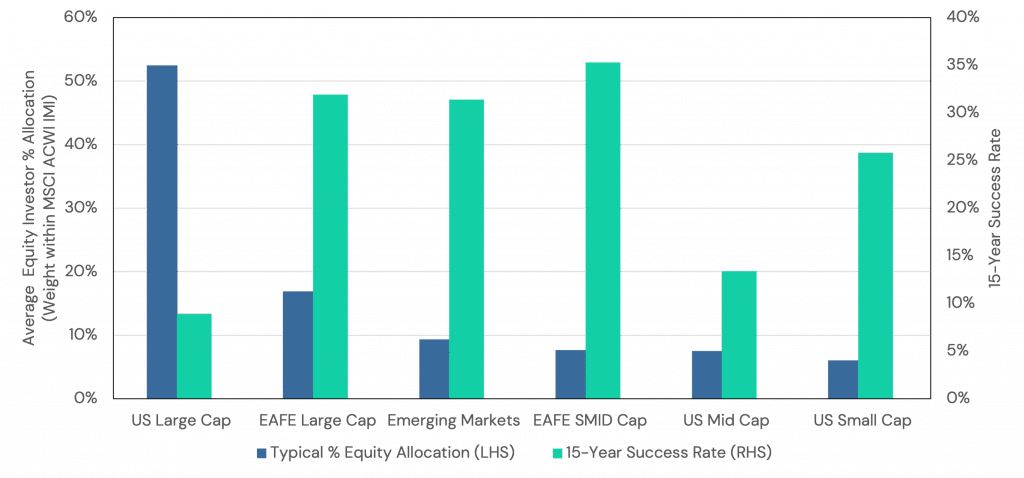
Every portable alpha program comes down to two decisions: how to obtain the market exposure, and where to invest the capital that this frees up.
(For a step-by-step explanation of how the pieces combine, including the financing-cost hurdle the alpha source must clear, see What is Portable Alpha?)
Obtaining the Beta
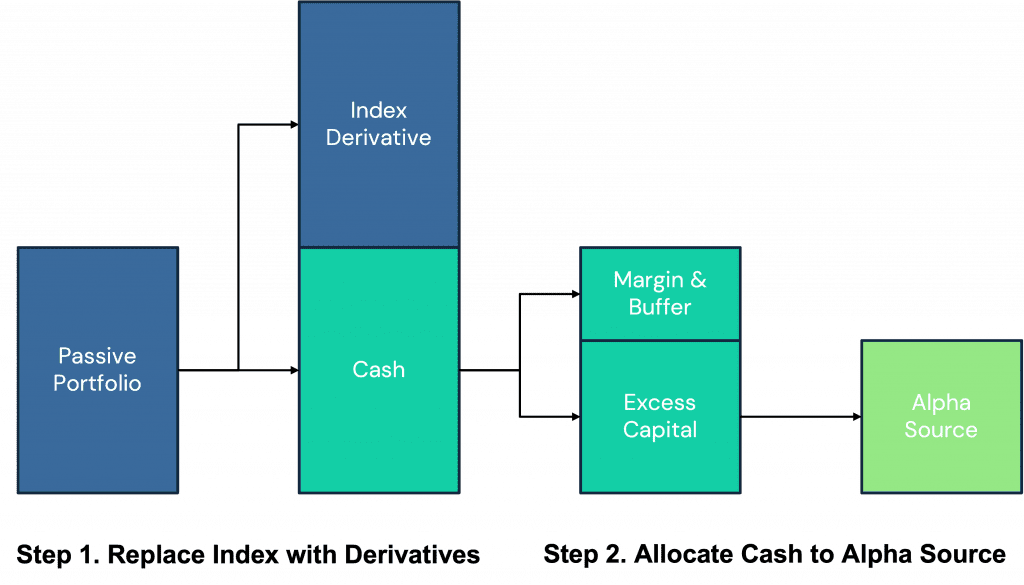
Institutions have generally used one of two instruments.
Futures contracts: Exchange-traded, standardized, usually highly liquid. Margin is a fraction of notional and the financing cost is built into the price. They're marked to market daily, so losses have to be paid in cash as they occur.
Total Return Swaps: Can be written on almost any index, with the financing rate set in the contract. They're bilateral, so they need ISDA documentation and carry counterparty risk.
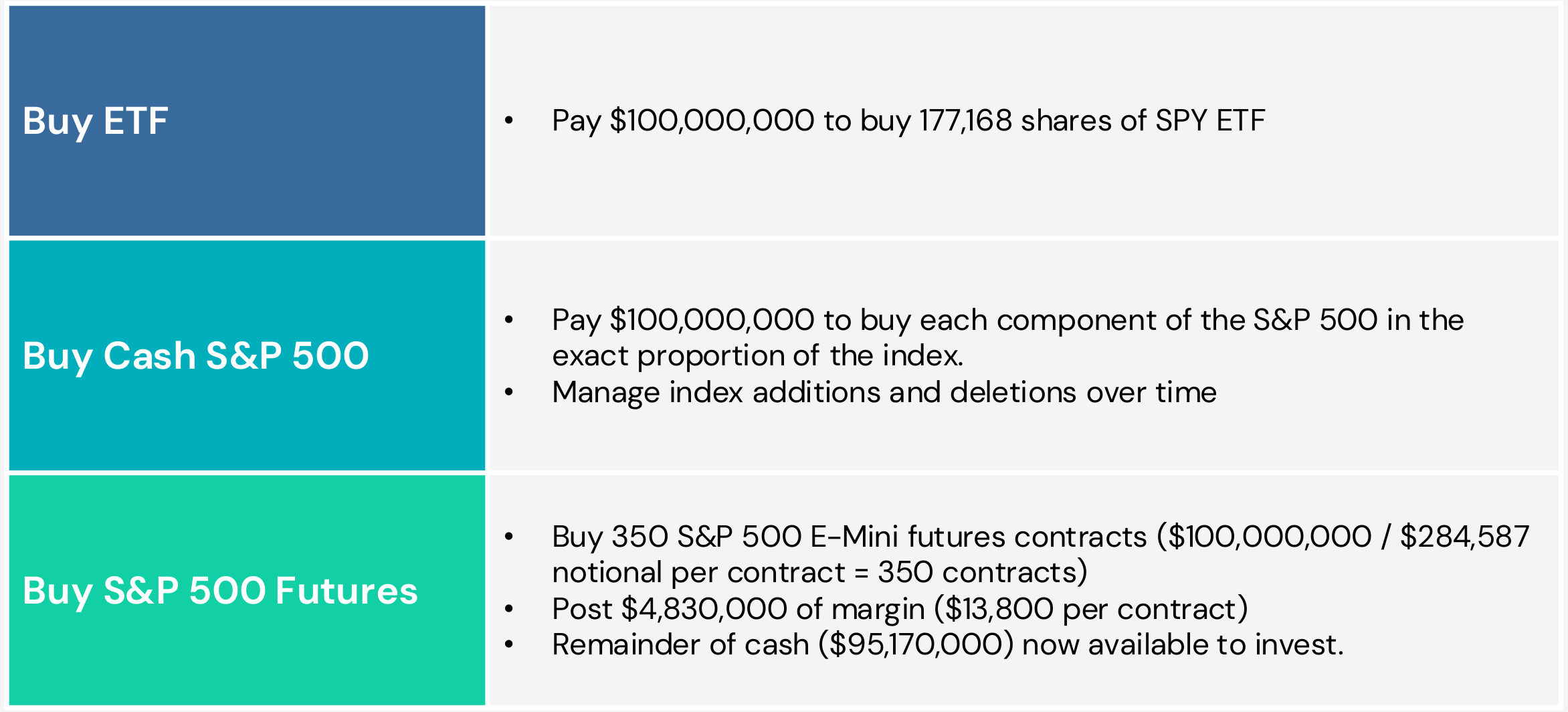
Either way, not all of the freed capital is free. Part of it has to stay in cash or T-Bills for margin calls, and that reserve sets how much can go to the alpha source.
Choosing the Alpha Source
Active fixed income and enhanced cash: Short-duration bond portfolios that seek returns modestly above cash. This was the original StocksPLUS design.
Hedge fund strategies: Strategies like long/short equity, global macro, and event-driven investing, potentially generating uncorrelated market returns.
Private markets and real estate: Some programs use them, but their illiquidity can be a poor match for a derivative overlay. When the overlay loses money it needs cash immediately, and private assets often cannot be sold quickly or at a fair price. That pairing was a factor in some of the failures of 2008.
Whatever the source, the practical tests are the same:
- Can its return above cash reasonably be expected to exceed the financing spread?
- Is it genuinely independent of the beta it sits on, including in a market crisis?
- Is it liquid enough to raise cash when the overlay needs it?
Each choice brings its own risks. The derivative overlay adds leverage, so the combined position can lose more than an unlevered holding of the same index. If the alpha source's return above cash falls short of the financing spread, the program underperforms simply owning the index.
Case Studies and Real-World Applications
The Missouri State Employees’ Retirement System (MOSERS). At the time of a 2024 profile5, MOSERS had run a portable alpha program for more than 15 years, and its approach had influenced other pension plans in the state.
Delta Air Lines. After the airline's bankruptcy, Delta's pension fund, under CIO Jonathan Glidden, adopted a hybrid portable alpha approach, working with consultants including UBS and Goldman Sachs for manager selection and advice. A profile of the program1 credits the strategy with a significant part of the fund's recovery. We cover the program in more depth in our Delta Air Lines case study and our podcast conversation with Jonathan Glidden.
Adoption and retreat. A 2015 Cambridge Associates survey revealed that nine out of eleven large U.S. institutions utilized portable alpha, some since the 1990s. Others abandoned the strategy after the financial crisis due to poor results.6 Taken together, these cases show how much depends on risk management, on choosing the alpha source well, and on understanding how the structure behaves in a downturn.
How Have Institutions Managed the Risks?
Running a portable alpha program is mostly an exercise in risk management. Large programs have typically relied on four disciplines.
Sizing the leverage. Programs set limits on total exposure relative to capital and decide in advance how large a drawdown they can absorb. These limits, more than the choice of alpha source, determine how much damage a bad year can do.
Keeping enough cash. The overlay's losses are settled in cash, daily in the case of futures. Programs size their liquidity reserve against a severe market decline, not an average one, so that they are not forced to sell the alpha source at the wrong time.
Monitoring the alpha source. Due diligence does not end at selection. Programs track whether the alpha source's return above cash is still earning more than the financing spread, whether its correlation to the beta is creeping up, and whether its liquidity terms have changed.
Rebalancing and stress testing. As markets move, the overlay and the alpha sleeve drift away from their targets. Programs rebalance on a schedule or at set thresholds. They use scenario analysis and stress tests, including a 2008-style episode in which beta and alpha fall together, to check that the structure would survive.
Behind all four sit operational and legal requirements: futures clearing accounts, swap documentation, custody and collateral agreements, and regulatory compliance. Those demands are a large part of why the technique stayed institutional for decades.
Even a well-run program carries risks that cannot be removed. The combined position can lose more than an unlevered holding of the same index. Swaps carry counterparty risk. And fees on the alpha source add to the hurdle it has to clear.
The Impact of Interest Rates on Portable Alpha
Higher interest rates raise the cost of financing the derivative overlay, which is generally the cash rate plus a spread. But any strategy or asset's return can also be split into the cash rate plus its return above cash. The cash rate appears on both sides and cancels, which leaves a single comparison: a strategy or asset adds value when its return above cash is greater than the financing spread, regardless of whether cash yields 1% or 5%.
Portable Alpha in Modern Portfolio Management
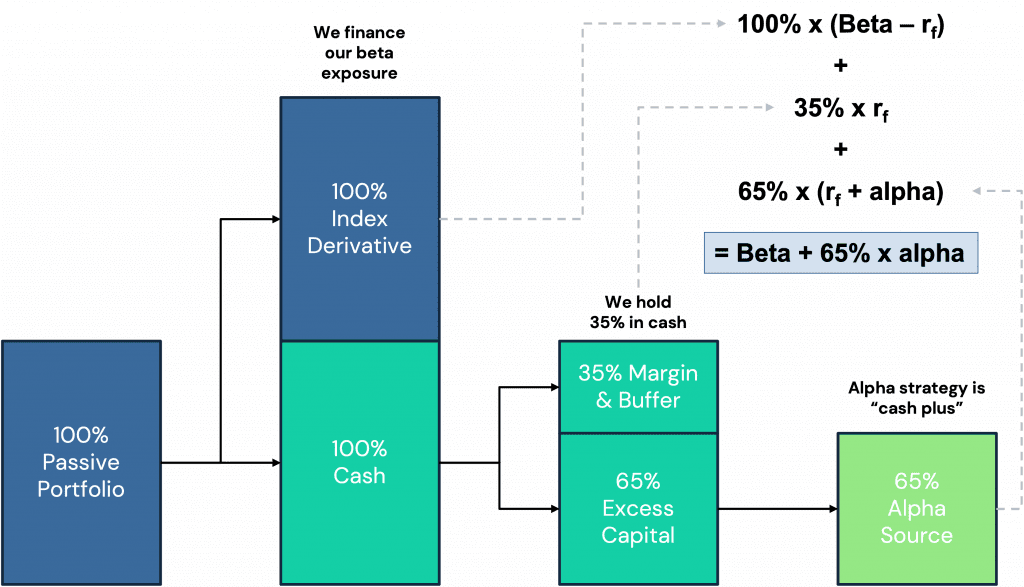
Portable alpha has become part of a broader shift in how institutions build portfolios, particularly those using risk-based frameworks that allocate according to each holding's contribution to total risk rather than its share of capital. Bank-provided quantitative index strategies and a wider range of liquid alternatives have expanded the menu of alpha sources, and low-cost index futures and ETFs have made the beta side cheaper to obtain. The complexity and risks have not gone away, however, and still call for expertise and disciplined risk management.
Regulation has also shaped who can use the technique. The SEC's Rule 18f-4 now governs how registered funds, including mutual funds and ETFs, can use derivatives: these are the rules under which fund-packaged versions of portable alpha operate.
For recent institutional survey data on how allocators are using portable alpha today, including the alpha sources and implementation structures they favor, listen to our webinar Alpha Unchained: What the Data Says about Portable Alpha's Institutional Moment.
Portable Alpha and the Emergence of Return Stacking
Return stacking applies the same capital-efficiency toolkit but packages the whole structure inside a single fund, so the fund provides more than one dollar of exposure for each dollar invested. For example, $1.00 of a core asset plus $1.00 of a diversifying strategy layered on top. An investor can add the diversifier without sacrificing the core exposure it would otherwise replace, and the futures, collateral, and daily operations that kept portable alpha institutional happen inside the fund.
The same hurdle applies: the stacked strategy has to earn more above cash than the financing spread. And because total exposure exceeds the capital invested, losses can be larger than those of the core holding alone. For a full explanation, see What Is Return Stacking?
Conclusion
Portable alpha separates two decisions that traditional portfolios bundle together: how much market exposure to hold, and where to look for additional return. Institutions have used it for four decades, and their results have depended on discipline: alpha sources that earned more above cash than the financing spread, stayed independent of the market, and stayed liquid enough to meet margin calls. Where those conditions failed, as in 2008, the structure amplified losses instead of adding return. Return stacking packages the same structure inside a fund, which removes much of the operational burden but not the underlying risk.